
How CMMS Supports Enterprise-Wide ESH Reporting

Maintenance data is the secret to reporting and improving on your Environmental, Social, and Health activities. Yet many organizations struggle with ESH reporting accuracy as 76% of executives cite data quality concerns as their primary challenge, and 81% face difficulties with documentation, review, and approval processes across their operations.
For enterprises operating multiple sites, the shift from fragmented spreadsheets to CMMS ESH reporting represents a fundamental improvement in how operational data supports environmental performance tracking, safety compliance verification, and enterprise-wide governance visibility.
This article examines how maintenance management platforms enhance ESH performance visibility through enterprise ESH data management, maintenance data for ESH reporting systems, and the integration of ESH reporting systems, which converts day-to-day maintenance activities into defensible environmental, safety, and health metrics.
Why ESH Reporting Breaks Down Across Large Organizations
Environment, Safety, and Health targets are often set centrally but measured inconsistently across sites, teams, and systems that don’t communicate with each other. The operational data needed for ESH reporting lives in maintenance records, facilities management systems, and asset databases that remain disconnected from enterprise reporting platforms, creating gaps that undermine credibility during audits.
| ESH Reporting Challenge | Impact on Data Quality | Impact on Compliance |
|---|---|---|
| Inconsistent Measurement | Different sites use different methods | Cannot aggregate enterprise-wide metrics |
| Fragmented Systems | Data scattered across 20+ systems | Manual consolidation introduces errors |
| Manual Processes | 60% of finance leaders struggle with data quality | Time-consuming, error-prone compilation |
| Poor Documentation | Missing timestamps, unclear attribution | Fails audit scrutiny |
Without a reliable operational data foundation, ESH reporting becomes manual, fragmented, and hard to defend when regulators or investors demand evidence supporting published metrics. More than half of executives (57%) cite data quality as the top ESH data challenge, with maintenance-related operational data contributing significantly to these quality concerns through inconsistent capture and storage methods.
The Role of Maintenance Data in ESH Performance
Maintenance activity directly influences energy efficiency, safe operation, and regulatory compliance in ways that become visible only when properly documented and analyzed. OSHA issued 29,590 citations in fiscal year 2023, with many violations tied to inadequate maintenance documentation, inspection records, or safety system upkeep that falls under the control of maintenance teams.

Ready To See For Yourself?
Preventive and predictive maintenance reduces emergency repairs, unsafe conditions, and non-compliant operations through maintenance contributions to ESH that occur systematically rather than reactively. Maintenance data provides measurable evidence that ESH controls are active and enforced through corrective action tracking, which connects equipment issues to their resolution and verification.
How CMMS Creates a Reliable ESH Data Foundation
CMMS captures asset-level data consistently across locations, teams, and time periods, eliminating the variation that makes enterprise ESH reporting unreliable. A majority (88%) of executives report data quality challenges in their top three ESH concerns, with standardized data capture through maintenance management systems directly addressing this widespread problem.
| Data Element | Manual/Spreadsheet Tracking | CMMS Standardization |
|---|---|---|
| Energy Consumption | Estimated, inconsistent units | Meter readings linked to assets |
| Safety Inspections | Paper checklists, gaps are common | Digital completion with timestamps |
| Emissions Sources | Assumed based on equipment type | Actual runtime and efficiency data |
| Compliance Tasks | Missed deadlines invisible | Automated tracking with alerts |
Standardized work orders, schedules, and asset records reduce variation in how organizations record ESH-relevant information across the enterprise through data consistency across systems. With LLumin CMMS+, maintenance data becomes structured, traceable, and suitable for enterprise ESH reporting through audit-ready ESH data that satisfies both internal and external verification requirements (e.g., CPD Climate Disclosures, GRI Sustainability Standards, Board/Investor Reports).
Supporting Environmental Reporting Through Maintenance Data
Energy-intensive assets rely on proper maintenance to operate within expected efficiency and emissions thresholds that environmental reporting requires organizations to track. Organizations that invest in maintenance programs decrease downtime by 44% while improving asset efficiency, which directly reduces energy consumption and emissions per unit of production.
Maintenance records help demonstrate control of energy use, emissions compliance, and unplanned downtime through environmental performance tracking that connects operational activities to measurable outcomes. Maintenance data in LLumin supports environmental reporting by linking asset condition with operational performance through asset energy efficiency tracking, which proves that environmental controls function as designed.
Strengthening Safety and Compliance Reporting at Scale
Safety inspections, corrective actions, and compliance tasks are core inputs into Environment, Safety, and Health reporting that must occur consistently across all enterprise locations. OSHA penalties can range from around $16,000 to over $100,000 per violation, with additional daily fines for unresolved issues that inadequate tracking systems fail to prevent.
| Safety/Compliance Activity | Without CMMS Integration | With CMMS Tracking |
|---|---|---|
| Safety Inspections | Paper forms, inconsistent completion | Digital checklists with mandatory fields |
| Hazard Identification | Email reports, lost in inboxes | Automatic work order generation |
| Corrective Actions | Follow-up unclear, often skipped | Tracked to completion with verification |
| Compliance Deadlines | Discovered during audits | Flagged in advance with escalation |
Disconnected tracking systems make it difficult to prove consistency across sites, undermining operational safety and environmental metrics that enterprise ESH reporting requires. CMMS ESH reporting records provide auditable evidence of inspections, follow-up actions, and accountability through safety inspection records that satisfy regulatory requirements and internal governance standards.
Enterprise Visibility and Governance Across Multiple Sites
ESH reporting requires consistency across regions, facilities, and business units that traditionally operate with significant autonomy. Without centralized systems, enterprise teams struggle to trust site-level ESH data because measurement methods, documentation quality, and reporting timing vary unpredictably across the organization.
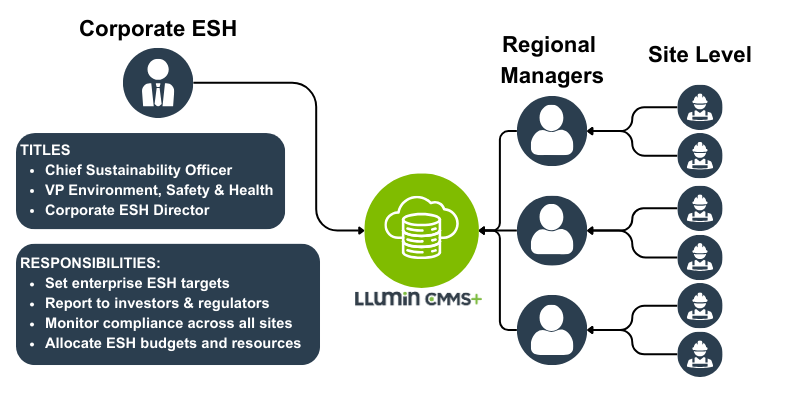
LLumin CMMS+ provides enterprise-wide visibility while maintaining local operational control through cross-site ESH visibility, balancing standardization with site-specific flexibility. This approach ensures corporate ESH teams can aggregate reliable metrics without forcing sites into rigid processes that don’t fit their operational reality through operational transparency maintained across organizational boundaries.
Turning Maintenance Activity into ESH-Ready Insights
Raw operational data must be structured, consistent, and exportable for ESH requirements that demand specific formats, timeframes, and verification levels. CMMS data reduces reliance on estimates and manual consolidation, which introduce errors and undermine credibility, through automated data capture that eliminates transcription and calculation mistakes.
| ESH Reporting Need | Manual Data Compilation | CMMS-Generated Reports |
|---|---|---|
| Energy by Facility | Spreadsheet consolidation, days of work | Pre-built report, filtered by location |
| Safety Incident Trends | Search paper logs across sites | Automated trend analysis with charts |
| Compliance Task Completion | Phone calls to verify status | Real-time dashboard showing all sites |
| Environmental Deviations | Scattered across email and forms | Centralized deviation tracking with CAPA |
When maintenance data is aligned with enterprise reporting systems, ESH metrics become defensible and repeatable through ESH reporting systems integration. Organizations with comprehensive documentation systems experience smoother audits with fewer findings while maintaining operational efficiency that supports both quality and productivity through systematic recordkeeping.
Build a Powerful Public Reputation with LLumin CMMS+
Enterprise ESH reporting relies on accurate and consistent data from day-to-day operations, which traditionally exist outside corporate visibility. CMMS ESH reporting provides the operational backbone that turns maintenance activities into measurable ESH evidence through maintenance data for ESH reporting, connecting frontline work to enterprise commitments.
Book a demo to see how LLumin CMMS+ supports enterprise-wide ESH reporting through unified maintenance records that demonstrate environmental control, safety compliance, and governance accountability across every facility in your operation. These records are supported by environmental risk control systems that function continuously.
Frequently Asked Questions
What ESH metrics can be supported by CMMS data?
CMMS data supports environmental metrics (energy consumption, emissions from equipment, waste generation, water usage), safety metrics (inspection completion rates, hazard identification and resolution, equipment-related incidents, PPE compliance), and governance metrics (regulatory compliance task completion, audit finding closure, training completion, contractor safety performance). 76% of executives cite data quality as their top ESH challenge, making the structured data capture provided by CMMS essential for credible reporting.
How does maintenance activity contribute to environmental reporting?
Maintenance activities directly influence environmental performance by maintaining equipment efficiency, which in turn reduces energy consumption. This is achieved through timely repairs, ensuring emission control systems function properly, and documenting environmental compliance tasks. Organizations that invest in maintenance programs decrease downtime by 44% while improving asset efficiency, which directly reduces per-unit environmental impact across operations.
Can a CMMS support ESH reporting across multiple sites?
LLumin CMMS+ provides enterprise-wide ESH visibility through centralized data capture with standardized formats across all sites, automated aggregation of metrics by facility, region, or business unit, consistent measurement methodologies regardless of location, and unified audit trails that prove enterprise-wide control. 88% of executives report data quality challenges in their top three ESH concerns, with multi-site consistency being a primary driver of these quality issues that CMMS directly addresses.
How does CMMS data improve ESH audit readiness?
CMMS improves audit readiness by maintaining complete, timestamped records of all maintenance and compliance activities. This provides instant access to documentation supporting ESH claims, demonstrating systematic control through automated schedules and completion tracking, and generating pre-formatted reports organized by regulatory requirement. OSHA issued 29,590 citations in FY2023, with many tied to inadequate documentation that comprehensive CMMS records prevent.
How does LLumin CMMS+ integrate maintenance data into enterprise ESH reporting?
LLumin CMMS+ integrates maintenance data through APIs that connect with enterprise ESH reporting platforms, standardized data exports in formats required by reporting frameworks, automated metric calculation from operational data, and dashboards that translate maintenance activity into ESH-relevant insights. 81% of executives struggle with documentation and approval processes in ESH reporting, making the automated workflows and approval tracking that LLumin provides essential for enterprise-scale ESH programs.

Karen Rossi is a seasoned operations leader with over 30 years of experience empowering software development teams and managing corporate operations. With a track record of developing and maintaining comprehensive products and services, Karen runs company-wide operations and leads large-scale projects as COO of LLumin.