
FMEA vs PFMEA: What’s the Difference?
Failure analysis works best when you use the right tool for the right problem. Failure Mode and Effects Analysis (FMEA) and Process Failure Mode and Effects Analysis (PFMEA) are both structured risk assessment methods. Evaluating when to use FMEA vs PFMEA (or knowing when to use both) depends on whether you’re evaluating a design, a component, or a process. Understanding the difference helps you apply each method where it actually reduces risk, rather than adding to problems they weren’t designed to solve.
Understanding Failure Analysis in Maintenance Management
FMEA gives maintenance and reliability teams a structured way to evaluate potential failures before they affect operations. Rather than reacting to breakdowns, FMEA encourages you to map:
- Where failures could occur, how severe the consequences would be.
- How often the failure might happen.
- How detectable it is before it reaches the end of the system.
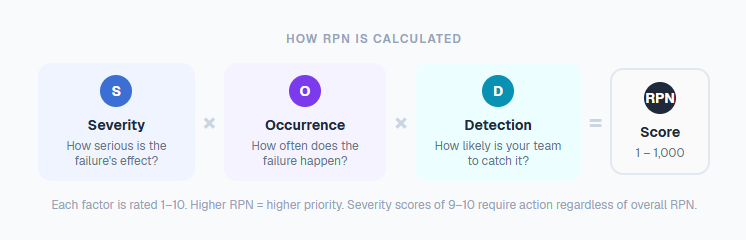
These three dimensions form the basis of every risk assessment in both FMEA and PFMEA. The output is a Risk Priority Number (RPN) that helps your team rank which failure modes require immediate attention and which can be monitored over time.
Computerized maintenance management system (CMMS) software centralizes the asset history and failure data. In addition to making it easier to calculate your RPN, it makes these risk calculations accurate rather than estimated. Without reliable maintenance records, your severity and occurrence ratings are built on assumptions rather than evidence.
Book a Demo to see how LLumin CMMS+ supports your failure analysis workflows.
What Is FMEA?
FMEA stands for Failure Mode and Effects Analysis. It is a step-by-step method for identifying every potential way a product, system, or component could fail. In addition, it can show teams what would happen if it did. In the modern workflow, it has become a standard reliability engineering tool across manufacturing, automotive, aerospace, and industrial maintenance.
In practice, you use FMEA to evaluate a component or system and assign three scores for each potential failure mode:
- Severity (S): How serious is the effect of this failure on the system or end user?
- Occurrence (O): How frequently is this failure mode likely to occur?
- Detection (D): How likely is your team to detect the failure before it causes harm?
Multiplying those three scores produces the RPN. Higher RPNs flag the failure modes most likely to cause significant, hard-to-catch problems. The goal is to allocate resources to those who bear the greatest risk.
Asset management software improves this process by giving your team access to historical breakdown records. When your equipment history shows how often a specific failure has occurred in the past, your occurrence scores stop being guesses.
What Is PFMEA?
Process Failure Mode and Effects Analysis (PFMEA) applies the same structured framework as FMEA, but focuses exclusively on the process. FPMEA focuses on the specific steps required to manufacture, assemble, or maintain a product rather than the product or system itself. For example:
- FMEA might ask, “Could this motor bearing fail?”
- By contrast, a PFMEA asks, “Could the procedure for replacing that bearing introduce errors that cause the next failure?”
PFMEA examines potential failure sources across six main categories: manpower, methods, materials, machinery, measurements, and the environment. These are the variables that introduce process variation, and process variation is what PFMEA is designed to expose and control.
A CMMS supports this analysis by giving your team access to downtime history and repair cost records tied to specific assets. When you can see repeat failure frequency following maintenance, that pattern directly informs your occurrence and severity ratings in the PFMEA.
The Core Differences Between FMEA vs PFMEA
Both FMEA and PFMEA methods use the same RPN framework. The difference comes down to what each one analyzes, when it’s applied, and what action follows from a high-risk finding.
Scope and Focus
FMEA evaluates the product or system, identifying potential design failures before they get built into the equipment. PFMEA narrows to the process, examining whether the steps required to manufacture or maintain something are inherently reliable.
Think about a motor component that is failing repeatedly:
- FMEA would evaluate whether the component itself is properly specified for the load and environment in which it operates.
- PFMEA would evaluate whether the maintenance procedure for that component is introducing errors that accelerate wear or mask early warning signs.
It’s important to remember that both questions matter. Just understand that they’re asking different things about the same problem.
Timing and Application
FMEA is typically conducted during the early design or specification stage, before the product or system is built. It establishes a baseline reliability picture that informs procurement, engineering, and maintenance strategy from the start.
PFMEA is developed before manufacturing or implementation begins, but unlike a traditional FMEA, it’s treated as a living document. Your team updates it whenever significant changes occur. That includes new equipment, revised procedures, different operating environments, or shifts in available resources.
Optimizing your preventive maintenance scheduling requires the kind of process review that PFMEA is designed to support. When your schedules are grounded in a current PFMEA, the maintenance steps they prescribe reflect how your process actually works.
Risk Prioritization
Both methods calculate an RPN using the same severity, occurrence, and detection inputs. What differs is what a high RPN triggers.
In a traditional FMEA, a high RPN typically leads to a physical design change. This might take the shape of modifying a component, changing a material specification, or adjusting an engineering parameter. In a PFMEA, a high RPN leads to the creation or revision of a process control plan. More specifically, a documented set of actions that reduces the likelihood or impact of the failure mode at the process level.
Whether you prioritize FMEA vs PFMEA, there is one risk prioritization rule that applies to both. A high severity score warrants immediate attention regardless of where the overall RPN lands. A failure with low occurrence and detectable symptoms can still require action before the RPN calculation makes it obvious.
How CMMS Software Supports Failure Analysis
Without structured historical data, failure mode identification relies on assumptions. Your severity scores reflect what you think will happen. By contrast, your occurrence scores reflect how often you believe something has happened. In the end, neither is as reliable as a maintenance record that shows you what the equipment has actually done.
A CMMS collects equipment breakdown history, repair costs, work order frequency, and failure patterns tied to specific assets. ReadyAsset connects asset history, prior failure records, and maintenance documentation directly to individual assets. That data gives your FMEA and PFMEA inputs a factual foundation.
Tracking repair costs over time also ensures that financial consequences are accurately reflected in your severity scores. An asset with inexpensive failures that occur frequently may carry a different severity profile than one with rare but operationally catastrophic failures. In addition, it should include the cost record that makes that distinction visible rather than assumed.
For teams conducting root cause analysis alongside FMEA, the same data foundation applies. Both methods improve in direct proportion to the quality of the maintenance history behind them.
Turn Analysis Into Action With LLumin CMMS+
Failure analysis produces value only when its findings translate into updated procedures, revised schedules, or improved monitoring. Therefore, the answer to the question of FMEA vs PFMEA matters less than what your team does with the results.
LLumin CMMS+ connects your analysis outputs directly to maintenance action. Preventive maintenance schedules can be refined based on failure mode findings. Condition-based maintenance triggers can be configured to flag the early indicators your FMEA identified as high-detection-risk. Work orders can be created, assigned, and tracked against the specific failure modes your team is targeting.
That connection is where enterprise asset management software closes the gap that most failure analysis programs leave open. Your team identifies the risk. LLumin makes sure the response is scheduled, assigned, and documented.
Book a Demo to see how LLumin CMMS+ supports your failure analysis program from data collection through corrective action.
Frequently Asked Questions
What’s the main difference between FMEA and PFMEA?
FMEA evaluates potential failures in a product, component, or system design. PFMEA evaluates potential failures in the process used to manufacture, assemble, or maintain that product. FMEA asks whether the design could fail. PFMEA asks whether the procedure could fail. Both use RPN scoring, but a high FMEA RPN typically leads to a design change, while a high PFMEA RPN leads to a new or revised process control plan.
How does CMMS software improve failure mode and effect analysis?
A CMMS provides asset history, breakdown records, and repair cost data that make FMEA inputs more accurate than estimates. Severity scores reflect actual failure consequences documented in work orders. Occurrence scores reflect real breakdown frequency from maintenance history. Without that data, FMEA and PFMEA risk assessments rely on engineering judgment alone.
Why is PFMEA important for process stability?
PFMEA maps where process variation introduces failure risk across manpower, methods, materials, machinery, measurements, and environment. Identifying and updating those variation points reduces the likelihood that procedural errors cause equipment failures or production defects over time.
How do you calculate a Risk Priority Number (RPN)?
RPN = Severity × Occurrence × Detection, with each factor rated on a 1–10 scale. Severity reflects the seriousness of the failure’s effect. Occurrence reflects the frequency with which the failure mode is expected to occur. Detection reflects the likelihood that a failure will be caught before it impacts operations. A higher RPN indicates a higher-priority failure mode, though high-severity failures warrant immediate attention regardless of overall RPN.
How does PFMEA connect to root cause analysis?
PFMEA identifies where in a process a failure mode could originate. Root cause analysis investigates why a specific failure has already occurred. PFMEA is proactive and predictive, while AI-driven root cause analysis is investigative and retrospective. When PFMEA findings are informed by completed root cause analyses, the process controls target failure causes that have already proven themselves in practice.

With over two decades of expertise in Asset Management, CMMS, and Inventory Control, Doug Ansuini brings a wealth of industry knowledge to the table. Coupled with his degrees in Operations Research from both Cornell and University of Mass, he is uniquely positioned to tackle complex challenges and deliver impactful results. He is a recognized expert in integrating control systems and ERP software with CMMS and has extensive implementation and consulting experience. As a senior software architect, Doug’s ability to analyze data, identify patterns, and implement data-driven approaches enables organizations to enhance their maintenance practices, reduce costs, and extend the lifespan of their critical assets. With a proven track record of excellence, Doug has established himself as a respected industry leader and invaluable asset to the LLumin team.