
How to Increase Asset Resale Value with Maintenance History Data
Many organizations lose substantial value at disposition because construction equipment often loses 20-30% of its value within the first year, with resale pricing determined more by buyer uncertainty than actual asset condition. With clear, traceable maintenance data from a high-level CMMS, you can set higher price tags for resale assets that buyers simply can’t argue with.
For equipment-intensive operations selling used machinery, vehicles, or infrastructure assets, the shift from scattered paperwork to comprehensive maintenance documentation represents a fundamental improvement in how residual asset value is protected and realized during equipment resale transactions.
This article examines how to increase asset resale value with maintenance data, maintenance records for equipment resale, and the asset disposition documentation that turns equipment condition transparency from an assumption into verifiable evidence supporting higher asking prices.
The Impact of Maintenance Records on Second-Hand Asset Pricing
Most assets lose value not because they fail, but because buyers cannot verify how they were maintained throughout their operational life. In secondary markets, uncertainty around condition, usage, and care translates directly into lower offers as buyers build risk premiums into their valuation calculations. As of 2023, the market size for used construction equipment is $109 billion, projected to reach $152 billion by 2028, making documentation practices that protect resale value increasingly critical as this market expands.
| Documentation Scenario | Buyer Perspective | Pricing Impact |
|---|---|---|
| No Maintenance Records | Assumes worst-case: deferred maintenance, hidden issues, unknown failures | Discounts of 25-40% from comparable units with records |
| Partial/Scattered Records | Questions completeness, worries about gaps in care | Discounts of 15-25% due to uncertainty |
| Complete Digital History | Sees verified care, known condition, predictable costs | Willing to pay a premium of 10-20% over poorly documented units |
Maintenance history data turns asset condition from an assumption into evidence, giving sellers leverage during valuation and negotiation through verified service records that reduce buyer risk perception. Preventive maintenance records signal a lower likelihood of hidden defects, deferred work, or imminent failure through equipment ownership history that demonstrates systematic care rather than reactive crisis management.
How To Increase Asset Resale Value With Maintenance Data
Buyers pay more for assets with transparent service histories because documented care reduces perceived risk and future cost uncertainty. Consistent, well-structured maintenance data allows sellers to justify pricing rather than accept buyer-driven discounts based on assumption and speculation.
Let’s examine a real-world example of reselling a mobile crane for construction to demonstrate the tangible financial impact of maintenance documentation quality.
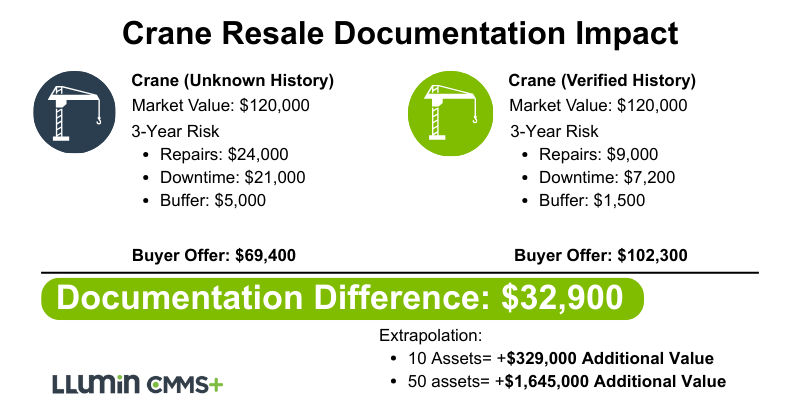
When buyers cannot verify service intervals, parts quality, or unresolved issues, they build substantial risk premiums into their offers that reflect uncertainty about future costs and failures. For example:
| Cost Element | Buyer Assumption (No Records) | 3-Year Impact |
|---|---|---|
| Unplanned Repairs | $8,000/year (high risk assumption) | $24,000 |
| Downtime | 12 hours/year × $600/hour | $21,600 |
| Risk Contingency Buffer | One-time protection against unknowns | $5,000 |
| Total Risk Penalty | — | $50,600 |
| Rational Offer | $120,000 baseline – $50,600 penalty | $69,400 |
Without preventive maintenance evidence to reduce uncertainty, buyers protect themselves through aggressive discounting that assumes worst-case scenarios for buyer due diligence purposes. Complete maintenance records, on the other hand, allow buyers to see preventive maintenance completion, service intervals, and major repairs, dramatically tightening risk assumptions and reducing protection margins.
| Cost Element | Buyer Calculation (With Records) | 3-Year Impact |
|---|---|---|
| Unplanned Repairs | $3,000/year (verified PM reduces risk) | $9,000 |
| Downtime | 4 hours/year × $600/hour | $7,200 |
| Risk Contingency Buffer | Minimal (uncertainty eliminated) | $1,500 |
| Total Risk Penalty | — | $17,700 |
| Rational Offer | $120,000 baseline – $17,700 penalty | $102,300 |
The central takeaway here is that experienced buyers don’t pay more “because the records look nice.” These decisions are carefully calculated based on expected future costs and eliminate the need for a protection buffer against unknowns, supporting a higher asking price through asset condition transparency.
Why the Asset Resale Value Has Changed
In this example, good records support a higher asking price of $32,900 (a 47% increase over the poorly documented scenario). Now, extrapolate this across all assets you plan to resell, using lifecycle cost tracking to protect value from acquisition through disposition.
CMMS Capabilities That Support Higher Asset Asking Prices
Centralized, Asset-Level Maintenance Histories
Buyers want to see a complete record tied to the asset, not scattered documents or partial exports that require reconstruction and verification. A single, continuous history makes it easier to demonstrate consistent care over the asset’s life through complete maintenance audit trails.
| Documentation Element | Scattered Paper/Spreadsheets | Centralized CMMS |
|---|---|---|
| Completeness | Gaps from lost records, incomplete entries | Every maintenance event captured |
| Accessibility | Search through file cabinets, multiple sources | Instant retrieval by asset ID |
| Verification | Difficult to prove authenticity | Timestamped, unalterable records |
| Format | Inconsistent, hard to review | Standardized, professional reports |
LLumin CMMS+ maintains a complete, time-stamped maintenance record for each asset that can be reviewed or shared during resale through asset transfer documentation that presents equipment history professionally and comprehensively.
Preventive Maintenance Evidence and Schedule Adherence
Preventive maintenance records show that assets were proactively protected, not just repaired after failure, which is ultimately a critical distinction that significantly impacts buyer confidence. Looking specifically at years 1-3, the typical crawler excavator depreciates 32 percent, with proper maintenance slowing this depreciation curve through demonstrated care.
| PM Documentation | Impact on Buyer Confidence | Pricing Effect |
|---|---|---|
| Complete PM Schedule | Shows a systematic care approach | Reduces risk discount 15-25% |
| Consistent Execution | Proves discipline, not just plans | Supports premium pricing |
| No Overdue Tasks | Eliminates concerns about deferred maintenance | Justifies top-tier valuation |
| Parts Documentation | Verifies quality components used | Increases perceived reliability |
Maintenance histories in LLumin show how preventive maintenance was scheduled and executed over time through preventive maintenance evidence, proving disciplined asset care that protects residual asset value throughout the ownership period.
Repair and Issue Resolution Transparency
As a rule, buyers assess how problems were handled, not just whether they occurred, making complete documentation of faults, fixes, and outcomes essential for maintaining buyer confidence. Clear documentation of issues reduces concern about recurring problems through operational reliability proof.
| Repair Documentation | Buyer Concern | CMMS Solution |
|---|---|---|
| Issue Identification | Was the problem found proactively or after failure? | Work orders show the detection method |
| Root Cause Analysis | Will this happen again? | Documentation shows the cause identified |
| Fix Quality | Was the repair done properly? | Photos, parts used, testing results |
| Follow-Up Verification | Did the fix work? | Closed-loop verification records |
Comprehensive maintenance histories, by contrast, show how issues were identified, resolved, and verified over time through maintenance cost history, demonstrating that problems were managed systematically rather than ignored or inadequately addressed.
Exportable Records for Due Diligence
Poorly formatted or incomplete records slow buyer reviews and weaken negotiating positions by raising questions about what else might be missing. Clean, asset-specific documentation speeds up due diligence and builds trust by presenting asset disposition documentation professionally.
| Export Capability | Manual Compilation | CMMS Export |
|---|---|---|
| Report Format | Inconsistent, hard to review | Professional, standardized |
| Completeness | Often missing pieces | All records included |
| Generation Time | Days to compile manually | Minutes to export |
| Customization | One-size-fits-all or none | Tailored to buyer needs |
If you want to increase asset resale value with maintenance data, a high-level CMMS provides a variety of workarounds to this problem. For example, Llumin allows teams to export structured maintenance histories tailored for external review through used equipment maintenance history reports that comprehensively and professionally present asset care, accelerating buyer decision-making while supporting higher valuations.
Turn Maintenance Records into Financial Leverage with LLumin CMMS+
Asset resale value depends on confidence, and confidence comes from evidence that reduces buyer uncertainty about future costs and reliability. LLumin CMMS+ helps teams protect asset value and support stronger resale negotiations through Construction Equipment Maintenance Software that captures complete equipment ownership history from acquisition through disposition.
Book a demo below to see how LLumin CMMS+ helps organizations increase asset resale value with maintenance data through systematic recordkeeping that turns every maintenance event into evidence supporting higher asking prices during used equipment sales.
Frequently Asked Questions
Why does maintenance history affect asset resale value?
Maintenance history affects resale value because buyers build risk premiums into offers when they cannot verify equipment care, condition, and service consistency. Complete records reduce buyer uncertainty about future costs and failures, allowing them to offer higher prices. Construction equipment often loses 20-30% of its value within the first year, with maintenance documentation significantly influencing depreciation rates and resale pricing throughout the asset lifecycle.
What maintenance records do buyers typically request?
Buyers typically request preventive maintenance schedules with completion records, major repair documentation with parts used and outcomes, service interval verification showing adherence to manufacturer recommendations, inspection records demonstrating systematic monitoring, and issue resolution documentation proving problems were addressed properly. The used construction equipment market reached $109 billion in 2023, with buyers in this expanding market becoming increasingly sophisticated about documentation requirements.
How detailed should maintenance history be for resale purposes?
Maintenance history should include work order details (what was done, when, why), technician attribution (who performed work, qualifications), parts documentation (OEM vs. aftermarket, lot numbers), completion verification (photos, test results), and cost tracking (labor, materials, downtime). The goal is to provide enough detail that buyers can confidently assess past care without overwhelming them with irrelevant information, striking a balance between comprehensiveness and usability.
Can digital maintenance records replace paper or spreadsheet histories?
Digital CMMS records provide significant advantages over paper or spreadsheets by offering complete, unalterable audit trails that prove authenticity, standardized formats that accelerate buyer review, instant retrieval that speeds due diligence, and professional presentation that builds confidence. Crawler excavators depreciate 32% in years 1-3, with digital documentation helping slow this depreciation through verifiable care proof that paper systems cannot match.
How does LLumin CMMS+ support asset resale and transfer documentation?
LLumin CMMS+ supports asset resale by maintaining complete, timestamped maintenance histories for each asset, generating professional export reports tailored for external review, documenting preventive maintenance schedules with completion proof, tracking all repairs with parts used and outcomes, and providing digital verification that proves record authenticity. The platform transforms maintenance activity into resale-ready documentation that protects value throughout the ownership period and supports premium pricing during disposition.

Chris Palumbo brings over 13 years of expertise in B2B sales across diverse sectors including Manufacturing, Food and Beverage, Packaging, and Pharmaceuticals. Leveraging 6 years of leadership experience, Chris has successfully guided sales teams within Manufacturing and Distribution to achieve success, particularly in large capital expenditure projects. As Director of Business Development for LLumin, Chris oversees the identification of business opportunities, pushing the development and implementation of a robust business development strategy aimed at accelerating revenue growth. With a proven track record of excellence, Chris has established himself as a respected industry leader and invaluable asset to the LLumin team.