
How LLumin CMMS+ reduces spare parts inventory costs

Contrary to popular opinion, overspending on spare parts is more of a visibility problem than a purchasing one. Maintenance and procurement teams often fall back on defensive overstocking because they lack clear insights into actual usage patterns, resulting in obsolete inventory and rush orders in response to emergencies.
The average US manufacturer carries between $1.1 and $1.3 in spare parts for every dollar of equipment value, with 40% of that inventory obsolete, overstocked, or for equipment no longer owned. These hidden costs compound through various expenses (e.g., insurance premiums, wasted storage space, and emergency procurement), draining budgets while stockouts still occur when critical parts are actually needed.
This article examines how organizations can reduce spare parts costs through CMMS for spare parts inventory that connects maintenance history to purchasing decisions, CMMS inventory optimization to eliminate waste while maintaining availability, and spare parts use tracking that transforms reactive ordering into proactive cost control.
Why Spare Parts Bloat Drives Up Operational Costs
Excess inventory actively drains resources through:
- Carrying costs
- Obsolescence risk
- Operational inefficiencies that most teams dramatically underestimate.
The costs associated with these drained resources consume 25-30% of total inventory value annually through storage expenses, insurance premiums, depreciation, and capital tied up in parts that may never be used. Insurance companies charge 5% or more of total inventory value in premiums, meaning a facility with $5 million in spare parts pays $250,000+ annually just to (in some cases, unnecessarily) protect inventory.
The real problem here is that teams are holding the wrong parts in the wrong quantities. They don’t know what’s actually being consumed versus what is gathering dust on a shelf, leading to stockouts of critical components that could otherwise be avoided. Preventive maintenance, for example, can reduce spare parts costs simply by aligning stock levels with systematic data that transforms inventory from a cost burden into a strategic asset.
Common Causes of Spare Parts Overspend
Understanding why inventory costs spiral out of control is the first step toward fixing them. Most cases trace back to information gaps rather than purchasing mistakes. Teams make defensible decisions based on incomplete data, leading to predictable waste due to parts demand forecasting that is disconnected from actual equipment behavior. For example:
| Overspend Cause | How It Manifests | Annual Cost Impact | CMMS Preventation |
|---|---|---|---|
| Unverified Usage Data | Reordering without checking actual consumption rates | 20-30% of inventory value | Usage history is linked to every work order |
| Stockout Fear Overordering | Bulk purchases without data-driven justification | 40% obsolete inventory | Automated reorder points based on real usage |
| Duplicate Orders Across Sites | Multiple facilities purchase identical parts | 15-25% redundancy | Enterprise inventory visibility across locations |
| Inconsistent Inventory Counts | No info on real-time stock movements | 10-20% obsolete parts | Real-time updates with every transaction |
| Obsolete Parts Accumulation | No process for phasing out discontinued stock | 10-20% obsolescence | Automated alerts for slow-moving/unused items |
| Emergency Replacement Premium | Expedited orders with 50-100% price markup | $50,000+ per hour in downtime | Predictive alerts prevent emergency situations |
Without maintenance-linked inventory systems that connect parts consumption to specific assets, teams effectively have to operate in the dark. This means both:
- Overstocking based on fear.
- Still experiencing stockouts for items nobody realized were low through technician inventory logging capturing real-time usage patterns.
The common thread across all overspend causes is a lack of visibility that comprehensive CMMS platforms systematically eliminate by connecting purchasing decisions to actual maintenance demand.
How LLumin CMMS+ Reduces Inventory Costs
Reducing spare parts costs requires connecting maintenance reality to procurement decisions so inventory levels reflect actual equipment needs rather than defensive guesswork. The following sections detail how LLumin CMMS+ provides:
- Systematic tracking
- Automated alerts
- Cross-facility visibility
These tools transform inventory from a cost burden into a competitive advantage through data-driven inventory cost reduction.
Track Spare Part Usage by Asset and Work Order
Every part issued through LLumin ties directly to the specific asset and maintenance task consuming it, which has a couple of important effects on inventory:
- Creates usage patterns that reveal which parts are regularly needed versus rarely touched through maintenance-linked inventory, connecting every transaction to equipment history.
- Eliminates guesswork about reorder quantities by showing exactly how fast parts are consumed under real operating conditions.
- Prevents overstock of slow-moving items.
- Ensures critical spares remain available through avoiding stockouts based on evidence rather than assumptions.
This granular tracking reveals surprising patterns. First, parts that teams assumed were essential may go untouched for years, while items nobody prioritized turn out to drive significant consumption through inventory waste reduction. By consequence, this increased visibility transforms procurement from reactive emergency ordering into proactive planning aligned with actual equipment needs.
Set Accurate Reorder Points with Automated Alerts
LLumin lets you define thresholds for each part based on historical usage, equipment criticality, and supplier lead time, rather than relying on guesswork in preventive maintenance inventory planning and aligning stock levels with scheduled work.
Automated reorder points eliminate the cognitive load of manually monitoring hundreds or thousands of SKUs while reducing emergency orders that carry 50-100% price premiums for expedited shipping. Teams shift from reactive crisis management to proactive replenishment that maintains availability while minimizing inventory investment.
Improve Technician Accountability and Inventory Accuracy
The real-time capabilities inherent within the CMMS structure allow for more accurate reporting on parts being returned as well as those being issued. Because the CMMS provides immediate visibility, teams can more effectively:
- Reduce work order errors
- Eliminate separate error-prone inventory logs
- Prevent duplicate orders
- Reduce errors caused by informal “borrowing” that creates phantom stockouts
Perhaps most importantly, the reliability inherent in a CMMS-based system increases trust in available data, allowing for more spare parts ordering practices moving forward.
Consolidate Inventory Visibility Across Locations
LLumin centralizes part data across all facilities, giving enterprise teams a single accurate view that prevents redundant ordering when Site A purchases parts Site B already has in surplus through multi-site inventory, eliminating information silos.
This visibility supports smarter stock allocation by enabling part transfers between locations rather than new purchases, makes it easier to identify slow-moving items worth redistributing, and ensures high-value parts are tracked consistently across the organization through enterprise inventory visibility, revealing optimization opportunities hidden in fragmented systems.
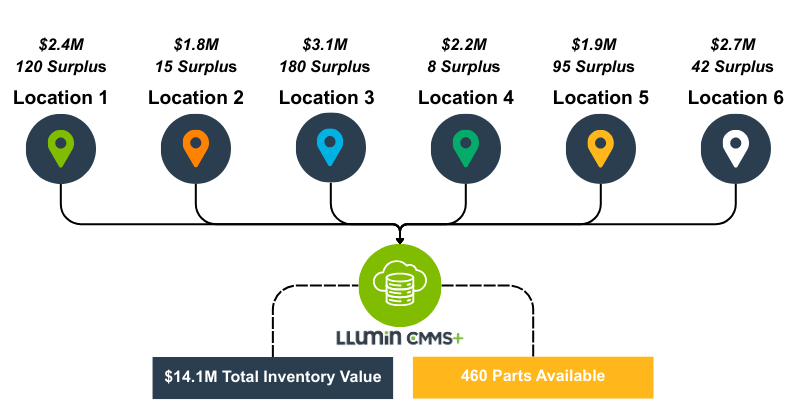
Multi-site visibility becomes especially valuable for organizations with regional facilities supporting similar equipment. Standardization opportunities become obvious when usage data consolidates, and emergency situations can be resolved through inter-site transfers faster than vendor orders through inventory alerts and thresholds that trigger proactive responses.
Link Parts to Preventive Maintenance Plans
Forecast future parts needs based on upcoming scheduled tasks rather than waiting for emergency failures to dictate purchasing through preventive maintenance inventory, which aligns procurement with maintenance calendars. This forward-looking approach helps:
- Align inventory levels with planned maintenance windows.
- Supports long-term cost control by preventing last-minute premium purchases.
- Maintains asset reliability by ensuring parts are available when scheduled work occurs through parts demand forecasting, converting reactive ordering into strategic planning.
When preventive maintenance schedules automatically generate part requirements weeks in advance, procurement teams can negotiate better pricing, consolidate orders to improve freight efficiency, and avoid the premium costs associated with emergency situations.
Identify and Phase Out Obsolete Inventory
Studies show 10-20% of spare parts inventory becomes obsolete annually as equipment is upgraded or replaced, yet without systematic tracking, these parts remain on the books indefinitely. LLumin flags items based on usage history, helping teams identify parts that haven’t moved in months or years, despite occupying valuable space and tying up capital through the removal of obsolete parts, freeing resources for productive investment.
Teams can systematically deplete or eliminate redundant stock before it becomes a permanent liability while freeing up storage space that enables better organization of active inventory. This will also reduce waste by catching obsolescence before parts deteriorate beyond usability through inventory waste reduction, preventing sunk costs.
Strengthen Vendor Performance and Procurement Planning
Analyzing order history, lead times, and part failure rates through LLumin enables teams to evaluate vendor reliability objectively rather than relying on anecdotal impressions because of the procurement efficiency measuring performance systematically. The platform:
- Supports tighter purchasing controls by requiring approval workflows for high-value purchases.
- Enables strategic procurement based on real usage patterns rather than emergency panic.
- Reduces costly last-minute orders while improving part availability
Perhaps most important of all, Llumin achieves these goals without bloating stock through multi-site inventory coordinating enterprise purchasing power. In addition, this coordination ensures that intelligence that informs contract negotiations and supplier selection through critical spares tracking prioritizes reliability where it matters most.
Cut Costs and Reduce Waste with LLumin Inventory Management
Spare parts overspend is a symptom of poor visibility, not poor planning. LLumin CMMS+ provides that visibility by giving maintenance and procurement teams the tools to manage inventory with clarity and confidence by connecting every part transaction to specific assets and work orders, automating reorder triggers based on real consumption patterns, and providing enterprise visibility that prevents duplicate purchasing across locations through spare parts use tracking, converting guesswork into data-driven precision.
Book a demo today to see how LLumin can help you reduce spare parts costs and streamline inventory across your entire operation, transforming spare parts from a cost burden into a competitive advantage through CMMS inventory optimization that reduces waste while maintaining the availability your assets demand.
Frequently Asked Questions
How does a CMMS help reduce spare parts inventory costs?
A CMMS reduces spare parts costs by linking every part transaction to specific assets and work orders, revealing actual usage patterns that eliminate guesswork in reorder decisions. The system automates reorder alerts based on real consumption data, prevents duplicate ordering through enterprise-wide visibility, and identifies obsolete inventory that drains resources. Preventive maintenance reduces spare parts inventory costs by 15-20% by aligning stock levels with planned maintenance rather than emergency response patterns.
What’s the best way to track usage of spare parts across assets?
The most effective approach ties every part issuance to a specific work order and asset through barcode or QR code scanning at the point of use. LLumin CMMS+ captures who used which part, on what equipment, for what maintenance task, and when. This creates a complete usage history that reveals consumption patterns, identifies high-wear components, and enables accurate demand forecasting without relying on manual logs prone to errors and delays.
Can LLumin CMMS+ support inventory visibility across multiple sites?
Yes, LLumin consolidates spare parts data across all facilities into a single enterprise view, preventing redundant purchasing when one location orders parts another already has in surplus. The platform enables inter-site part transfers, identifies standardization opportunities through usage comparison, and ensures high-value critical spares are tracked consistently across the organization.
How can CMMS prevent overordering or stockouts?
CMMS prevents overordering by setting automated reorder points based on historical usage rates, equipment criticality, and supplier lead times. The system triggers replenishment alerts before stockouts occur while preventing excess safety stock that ties up capital. Carrying costs consume 25-30% of inventory value annually, making accurate reorder points essential for controlling costs while maintaining availability.
Does LLumin CMMS+ integrate with procurement systems or ERP platforms?
LLumin integrates with major ERP and procurement platforms, enabling seamless data flow between maintenance operations and purchasing workflows. Purchase requisitions generated from inventory reorder alerts can flow directly into ERP approval processes, while procurement data feeds back into LLumin for complete visibility into order status and vendor performance. This effectively eliminates duplicate data entry and ensures maintenance and procurement teams work from a single source of truth.
