
How LLumin CMMS+ Prevents Stockouts and Over-Ordering
Rather than thinking of them as opposites, one of the best ways to manage stockouts and overordering is to see them as originating from the same source. Inventory carrying costs consume 25-30% of total inventory value annually. This is especially true when considering storage, insurance, and depreciation, while stockouts force 50-100% premiums on emergency parts orders.
This article examines how poor inventory management drives costs and chaos, the common causes of spare parts inventory problems, and how LLumin CMMS+ features prevent spare parts stockouts and overordering alike.
How Poor Inventory Management Drives Cost and Chaos
Overstocking, especially in cases resulting from warehouse optimization failures, wastes budget on low-use or obsolete parts that sit unused in storerooms. The penalties here have a doubling effect since the warehouse now has both:
- Too much of what they don’t need
- Not enough space to house what they actually need
These effects cascade into several areas affecting the overall business, including everything from carrying costs to insurance premiums to downtime costs:
The True Cost of Inventory Mismanagement:
| Cost Category | Annual Impact | Typical Percentage |
|---|---|---|
| Inventory carrying costs | 25-30% of total inventory value | Storage, insurance, and depreciation combined |
| Obsolete/excess inventory | 40% of total inventory | Parts for decommissioned equipment, overstocked items |
| Insurance premiums | 5%+ of inventory value | Annual coverage costs |
| Emergency parts premium | 50-100% price markup | Rush orders, expedited shipping |
| Unplanned downtime costs | $50 billion annually (US manufacturing) | Lost production, idle labor |
| Average excess inventory | $142,000 per business | Above demand requirements |
Source 1 | Source 2 | Source 3 | Source 4
Because the stakes are so high, especially in larger companies that often overestimate the padding on their budgets, mistakes here can cost hundreds of thousands of dollars, making it more important to have infrastructure that captures these problems before they occur. Platforms like Llumin CMMS+, for example, use advanced inventory usage tracking to reveal actual consumption patterns rather than defensive assumptions.
Common Causes of Spare Parts Inventory Problems
Most inventory problems trace to visibility gaps and disconnected systems rather than purchasing incompetence. Purchasing teams make rational decisions based on incomplete information that predictably lead to either stockouts or overstocking. In most cases, these problems can be solved by using a centralized database to ensure accurate reporting, enabling improved inventory forecasting.
Root Causes of Inventory Problems:
| Problem Cause | Stockout Risk | Overstock Risk | Solution |
|---|---|---|---|
| Manual tracking/ spreadsheets | High | High | Automated inventory tracking |
| No standard reorder rules | High | High | Usage-based inventory reorder rules |
| Lack of real-time visibility | Moderate | High | Real-time CMMS updates |
| Poor demand forecasting | High | High | Maintenance planning accuracy |
| Disconnected maintenance | Very high | Moderate | CMMS with procurement features |
Without a centralized system, these problems compound. For instance, maintenance planning accuracy deteriorates when procurement and maintenance operate in silos, creating vicious cycles where stockouts drive defensive overordering.
Discover how much you could save by optimizing spare parts inventory through systematic tracking and automated reorder points that eliminate guesswork.
LLumin CMMS+ Features That Prevent Stockouts and Over-Ordering
LLumin CMMS+ provides comprehensive inventory control capabilities that address root causes rather than symptoms. The platform actively prevents the dual threats of stockouts and excessive carrying costs through intelligent automation and real-time coordination across all stakeholders.
LLumin Inventory Management Overview:
| Capability | Stockout Prevention | Over-Ordering Prevention | Annual Savings Potential |
|---|---|---|---|
| Automated reorder rules | Triggers before stockouts occur | Orders only when thresholds are reached | 20-40% inventory reduction |
| Multi-site visibility | See parts at other locations instantly | Eliminate duplicate purchasing | 15-25% redundancy elimination |
| Built-in procurement workflows | Automatic PO generation from real needs | Approval controls prevent panic buying | 30-50% emergency order reduction |
| Vendor performance tracking | Identify unreliable suppliers causing delays | Choose proven suppliers, reduce buffer stock | 10-20% supplier-driven costs |
| Real-time mobile tracking | Instant visibility into stock movements | Prevents “just in case” reordering | $300K-$500K annually (mid-size manufacturer) |
| Dashboards and alerts | Proactive low-stock warnings | Highlights slow-moving/obsolete inventory | 40% inventory waste reduction |
Automated Reorder Rules Based on Real Usage
Inventory thresholds tailored by item, site, and consumption patterns prevent stockouts without excessive safety stock. It also focuses on prevention, ensuring that orders trigger automatically before stockouts occur based on real work-order history and actual usage rather than guesswork.
Automated Reorder Performance:
| Reorder Approach | Stockout Frequency (incidents/yr) | Excess Inventory Level (above optimal) | Annual Carrying Cost (% of inventory value) | Emergency Order Rate (% of all orders) |
|---|---|---|---|---|
| Manual/spreadsheet-based | 15-25 | 40% | 30% | 20-30% |
| Basic min/max (static) | 8-12 | 25% | 25% | 10-15% |
| Usage-based automated (LLumin) | 2-4 | 10% | 18-20% | <5% |
| AI-optimized forecasting | 1-2 | 5% | 15% | <2% |
Multi-Site Visibility to Reduce Duplicate Ordering
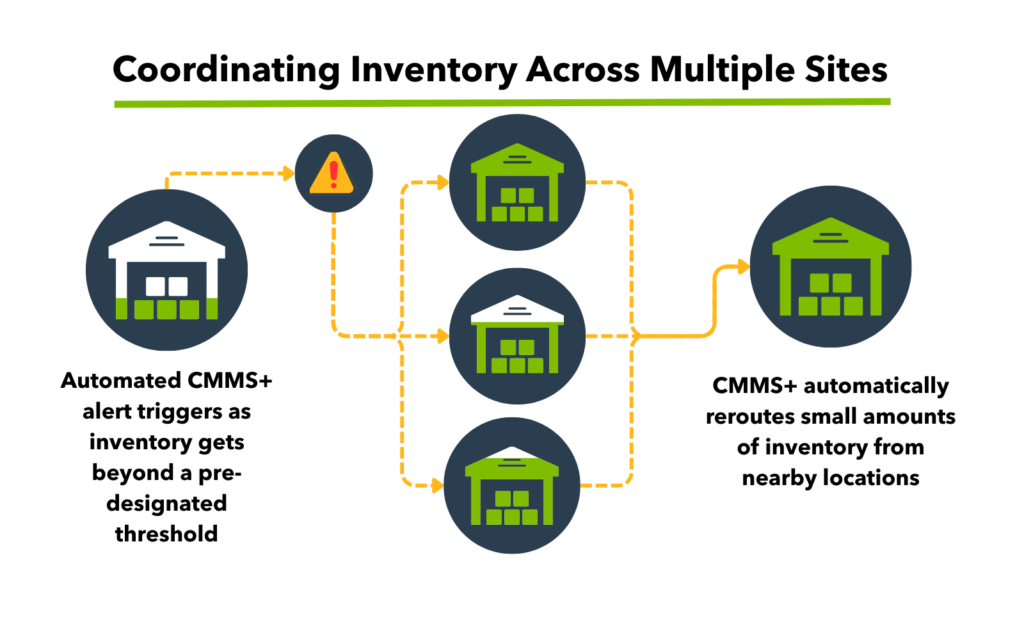
Teams view inventory across all sites in real time, enabling parts sharing between facilities, effectively eliminating information silos, and reducing reordering. In addition, LLumin reduces inventory duplication and waste across large operations by exposing surplus at one location that satisfies shortages at another.
Built-In Procurement Workflows
A CMMS with procurement features will automatically generate POs and approvals tied to real inventory needs, eliminating manual coordination delays. In addition, they track receiving, invoicing, and fulfillment from end to end through compliance-ready inventory records that provide complete audit trails.
Procurement Workflow Efficiency:
| Procurement Stage | Manual Process Time | LLumin Automated Time | Time Savings | Error Rate |
|---|---|---|---|---|
| Request creation | 10-15 min | 2 min | 80% faster | Manual: 15-20% Auto: <2% |
| Approval routing | 1-3 days | 2-4 hrs | 85% faster | Manual: 10% lost Auto: 0% |
| PO generation | 20-30 min | Automatic | 95% faster | Manual: 12% Auto: <1% |
| Vendor selection | 15-20 min | Instant | 90% faster | Manual: No data Auto: Data-driven |
| Receiving/invoicing | 30-45 min | 5-10 min | 80% faster | Manual: 18% Auto: <3% |
| Total cycle time | 3-5 days | 4-8 hrs | 90% reduction | Errors eliminated 85% |
Integrated Vendor Performance Tracking
Built-in vendor management tools automatically track vendor delivery times, product quality, and service issues. In addition, they help procurement teams choose reliable suppliers based on data rather than relationships.
Vendor Performance Metrics:
| Vendor Performance Factor | Impact on Stockouts | Impact on Costs | LLumin Tracking | Decision Support |
|---|---|---|---|---|
| On-time delivery rate | High | Moderate | Automatic timestamp tracking | Flag vendors <90% on-time |
| Lead time accuracy | High | High | Actual vs. promised comparison | Adjust reorder points |
| Part quality/failure rate | Moderate | High | Failure tracking by vendor | Qualify/disqualify suppliers |
| Responsiveness to issues | High | Moderate | Issue resolution time logged | Tier vendors by support |
| Price competitiveness | Low | High | Price history by part | Negotiate from data |
Real-Time Inventory Tracking with Mobile Access
Mobile access is perhaps one of the most critical aspects of modern maintenance management, as it enables technicians to update inventory immediately upon parts use, eliminating the lag between physical consumption and system records. Having this real-time visibility means procurement decisions are based on the current state rather than outdated snapshots.
Mobile Inventory Tracking Impact:
| Capability | Without Mobile CMMS | With LLumin Mobile | Improvement |
|---|---|---|---|
| Inventory accuracy | 60-70% | 95-98% | 35-40% improvement |
| Time to update records | 4-8 hours lag | Instant | Real-time vs. delayed |
| Parts location accuracy | 70% | 98% | 28-point improvement |
| Physical count time (Hrs per quarter | 16-20 hrs | 4-5 hrs | 73% faster |
| Duplicate part searches | 20-30% of lookups | <5% | 75% reduction |
Dashboards and Alerts for At-a-Glance Control
58% of retail brands and manufacturers have inventory accuracy below 80%, making dashboards a critical tool to help prevent spare parts stockouts before they occur. These dashboards can be customized to users’ needs to instantly highlight low stock, pending orders, and part usage patterns, with visibility into spare parts availability.
Dashboard & Visibility
| Dashboard Feature | User Benefit | Time Savings |
|---|---|---|
| Low stock alerts | Proactive reordering before shortage | 30 min daily |
| Slow-moving inventory report | Identify waste, free up capital | 2 hours monthly |
| Pending PO status | Track vendor delivery, escalate delays | 45 min daily |
| Usage trend analysis | Data-driven reorder point adjustments | 4 hours monthly |
| Multi-site stock levels | See enterprise inventory at a glance | 60 min daily |
| Parts availability by work order | Plan maintenance when parts are available | 90 min weekly |
Prevent Spare Parts Stockouts with LLumin CMMS+
Inventory bloat and part shortages drive up costs and delay maintenance when visibility gaps prevent proactive decisions. LLumin CMMS+ helps teams prevent spare parts stockouts by connecting them with powerful real-time tools that eliminate the dual threats of stockouts and excessive carrying costs.
Book a free demo to see how LLumin simplifies spare parts control with automated reorder rules, multi-site visibility, integrated procurement workflows, vendor performance tracking, real-time mobile updates, and comprehensive dashboards.
Frequently Asked Questions
How does LLumin help avoid duplicate orders across multiple sites?
LLumin provides real-time visibility into inventory levels across all facilities through a single centralized system. Before placing orders, procurement teams see which locations have surplus parts available for transfer, eliminating duplicate purchasing.
Can LLumin handle complex reorder rules for different storerooms?
Yes, LLumin enables customized reorder points for each part at each location based on site-specific consumption patterns, equipment criticality, and supplier lead times. Rules can vary by storeroom, facility, or equipment type—a high-volume production facility might maintain higher minimums than a low-use satellite location.
What types of inventory can LLumin CMMS+ track?
LLumin tracks all maintenance, repair, and operations (MRO) inventory, including spare parts, consumables, tools, safety equipment, and contractor-supplied materials. The system manages serialized items (motors, pumps) requiring individual tracking and bulk commodities (fasteners, lubricants) measured by quantity.
How does LLumin’s vendor management improve inventory accuracy?
LLumin captures vendor performance data automatically (e.g., delivery times, part quality, price variations, responsiveness to issues), enabling data-driven supplier selection. 72% of SMEs experience unpredictable delivery times, causing stockouts or defensive overordering.
Does LLumin CMMS+ integrate with financial or ERP systems for procurement?
Yes, LLumin integrates with major ERP and financial systems, including SAP, Oracle, Microsoft Dynamics, NetSuite, and QuickBooks. Purchase requisitions generated from inventory reorder alerts flow directly into ERP approval workflows, while procurement data feeds back into LLumin for complete visibility.

With over 15 years of experience, Ann Porten stands as a seasoned leader in asset management, ERP Solutions, and B2B Sales. Her extensive background in manufacturing has equipped her with unique insights, enabling her to navigate complex software solutions with precision and drive results. Currently, as the Director of Business Development for LLumin, Ann has led various industries, including Manufacturing, Construction, Pharmaceuticals, Food & Beverage, and Oil & Gas to identify their business opportunities and challenges, and implementing profitable solutions. Her reputation as a trusted advisor and industry leader stems from her dedication to delivering economic success and satisfaction to the customers she serves.