
Chapter Five: Embedding Proactive Maintenance Processes to Shorten MTTR for Unplanned Work
Planning for Reactive Maintenance
No predictive maintenance system can completely eliminate breakdowns. Rather than aiming for total perfection, you can achieve the greatest operational advantage with clear, well prepared sets of response plans.
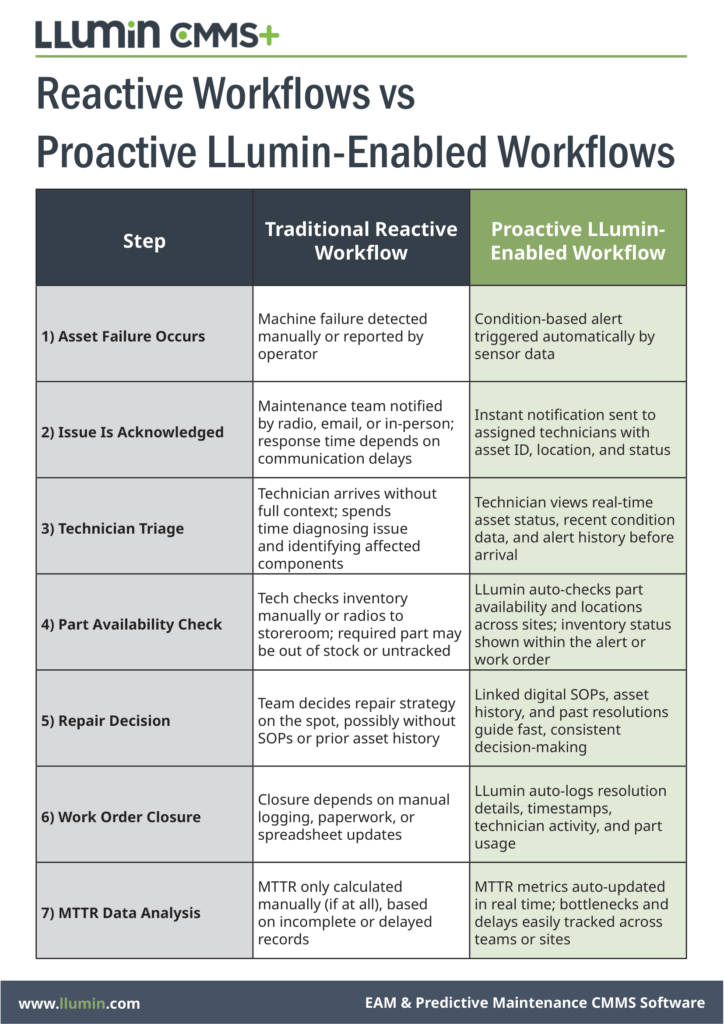
When the occasional asset failure does occur, LLumin’s historical data and automated workflows dramatically improve mean time to repair (MTTR) and the accuracy of reactive maintenance. These proactive maintenance processes give you much greater control even in unexpected circumstances.
As a result, repair time becomes predictable–and, more importantly, improvable.

Read Chapter Four
Get the greatest possible benefits from AI-powered predictive maintenance with our 7-step guide to enterprise-wide rollout.
Better Data and Workflows Reduce Lost Time
Following unexpected failure, LLumin rules will trigger and immediately allocate clear maintenance ownership to a skilled and available technician, and reserve the necessary parts. Since you can assign digital SOPS and maintenance instructions to each asset, that technician can also follow a standardized approach for repair.
This combination of factors–automated work orders, parts procurement, and accessible maintenance documentation–makes it easy to coordinate planned and reactive maintenance. And it’s one of the factors behind how LLumin cuts MTTR by up to 26% within 24 months.
That means more uptime even when emergencies occur, translating into major productivity gains across your operation.
How LLumin’s Proactive Maintenance Process Help Teams Act Faster
| Response Capability | How It Works | How It Shortens MTTR |
|---|---|---|
| Automate responses to real-world scenarios | When a defined event occurs (e.g. condition alert, operator request, asset state change) the system immediately launches a predefined workflow | The gap between detection and action disappears, reducing maintenance response times |
| Predefined condition thresholds | Alerts are tied to structured workflows rather than open-ended notifications | Technicians don’t waste time deciding what to do next under pressure |
| Complete automated workflows | The trigger automatically generates a work order, assigns a technician, attaches parts and instructions, and sets escalation paths | Planning and coordination happen instantly, reducing delays |
| Maintenance can start before inspection | Critical triggers can pre-authorize escalation levels, approvals, or contingency actions based on severity rules | Decisions that usually require supervisor sign-off happen immediately, preventing administrative delay |
| Multi-condition logic reduces noise | Work orders are only created when meaningful combinations of signals occur | Technician capacity isn’t diluted by false alarms, keeping response focused on real risk |
| Improve cross-team coordination | Relevant departments are notified simultaneously with clear expectations | Fewer handoffs and communication delays extend repair timelines |
Digital Resources Accelerate Maintenance Responses
Without computerized maintenance management system (CMMS) software, around 45% of a maintenance professional’s time is wasted retrieving the physical documents needed to complete a task.
But LLumin digitizes work orders, SOPs, maintenance histories, and other documentation, giving technicians immediate access on a cloud-based mobile device.
That means your team can instantly respond to emergency asset failures, almost doubling your maintenance efficiency even when they lack internet access in the field.
How LLumin Improves MTTR for Unplanned Work
| Digital Resource | What It Provides | Effect on MTTR |
|---|---|---|
| Digital SOPs | Asset-specific, step-by-step repair instructions embedded directly in the work order | Reduces hesitation and eliminates time lost deciding what to do next |
| Instant work order generation | Automatic task creation with priority, assignment, and due date when a trigger occurs | Removes administrative delay between detection and execution |
| Attached maintenance history | Immediate access to prior failures, past repairs, and known issues within the same screen | Speeds diagnosis and prevents repeated investigative steps |
| Standardized templates | Consistent repair workflows across sites and teams | Reduces variation and miscommunication that extend downtime |
| Real-time documentation | Updates captured as work progresses without separate data entry | Prevents follow-up confusion and shortens future troubleshooting cycles |
Achieve Record-Breaking MTTR with LLumin CMMS+
Implementing predictive maintenance lets you dramatically reduce the frequency of asset failures. But you also need AI-enhanced proactive strategies to remove the delay between failure detection and corrective action. That way, you can minimize MTTR even for unplanned work and drive maximum efficiency across your operation.
With automated workflows and digital resources that technicians can access on the go, LLLumin CMMS+ helps you engineer delays out of your maintenance response processes. So rather than reacting to sudden failures, your team can follow controlled responses that deliver measurable improvements in MTTR.
Book your free demo for a personalized tour of LLumin CMMS+.
Download Your Blueprint to AI-Powered Predictive Maintenance

Chris Palumbo brings over 13 years of expertise in B2B sales across diverse sectors including Manufacturing, Food and Beverage, Packaging, and Pharmaceuticals. Leveraging 6 years of leadership experience, Chris has successfully guided sales teams within Manufacturing and Distribution to achieve success, particularly in large capital expenditure projects. As Director of Business Development for LLumin, Chris oversees the identification of business opportunities, pushing the development and implementation of a robust business development strategy aimed at accelerating revenue growth. With a proven track record of excellence, Chris has established himself as a respected industry leader and invaluable asset to the LLumin team.