
Chapter Four: Moving from Condition-Based to Predictive Maintenance with AI
It’s Not Just About How Much Data You Have
Once you get started with condition-based maintenance, it’s easy to refine your alert rules, scale across assets and sites, and consistently build out a substantial set of data history. You can then use this level of scale to move towards predictive maintenance models and outcomes.
But predictive maintenance relies on consistent, labelled data rather than just large quantities. So while an active condition-based approach is a great first step, implementing AI-powered predictive and proactive maintenance takes a bit of preparation.
Read Chapter Three
Review the basics of condition-based maintenance and explore how LLumin helps you combine multiple signals for optimal scheduling.
Moving Towards Full AI Integration
Getting the Right Data in Place
While more difficult, it’s possible to manage condition-based maintenance in siloed PLCs, Supervisory Control and Data Acquisition (SCADA) systems, or maintenance logs. But when it comes to predictive maintenance, you need to connect your data to a single AI-driven computerized maintenance management system (CMMS) platform like LLumin.
During implementation, our team helps you integrate LLumin with your existing sensors and systems. Professional support makes it much easier to avoid duplicate data in CMMS integrations. And we ensure your condition data and maintenance histories are properly labelled and organized so your predictive model can learn effectively.
As well as basic data sets, you can also migrate your known condition alert patterns into LLumin. That way, your AI-powered predictive system already has plenty of knowledge and experience to draw upon from the moment it goes live.
Training Your AI Model
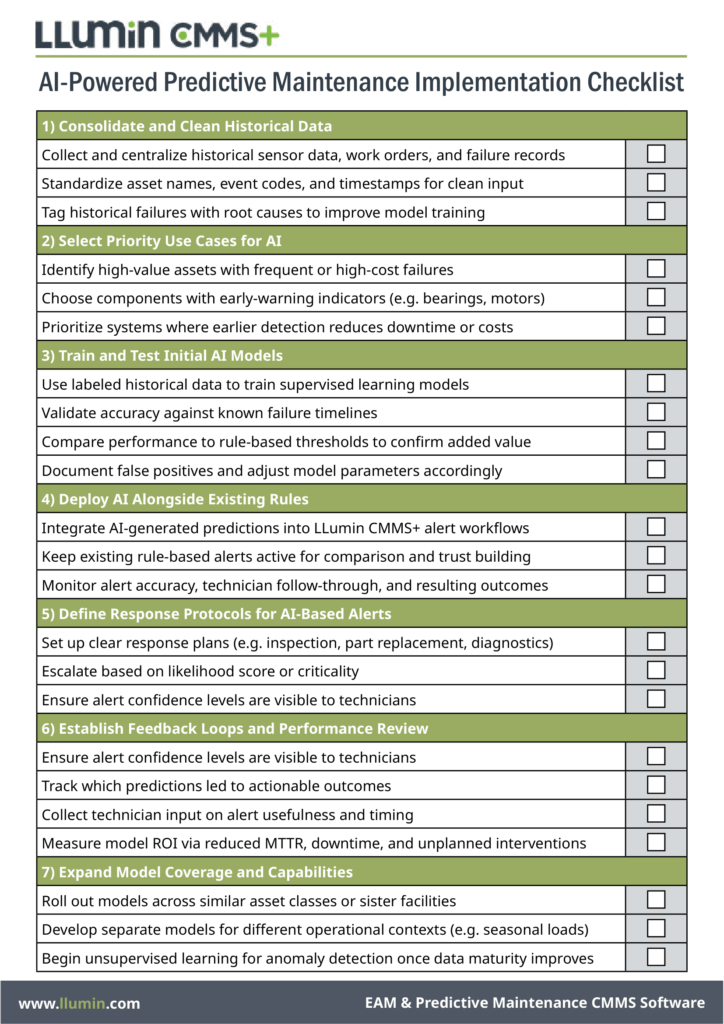
As with all changes to your maintenance strategy, it’s best to conduct your predictive maintenance rollout in increments. Start by implementing predictive models for the top 5-10% of assets that will offer the greatest return on investment (ROI) from improved maintenance.
Early predictive models rely on the data you provide to make decisions and offer recommendations for efficient maintenance management. But as time goes on and they gather a wealth of anomaly data, the accuracy of your AI alerts will improve. Every threshold breached, work order completed, and metric logged feeds into a continuous improvement loop that drives even better results.
With enough historical data, there might come a time when you can entirely replace static thresholds with adaptive condition monitoring. But at first, you’ll need to give your AI model a helping hand to ensure it has the greatest impact on your operation.
Track how often AI predictions lead to valid interventions. Then use what you learn to refine your thresholds and retrain models to better respond to asset needs.
Over time, your model will need less and less intervention, until you can rely on it completely to automate your maintenance responses in the most efficient way possible.
Scaling Predictive Models Across Assets and Facilities
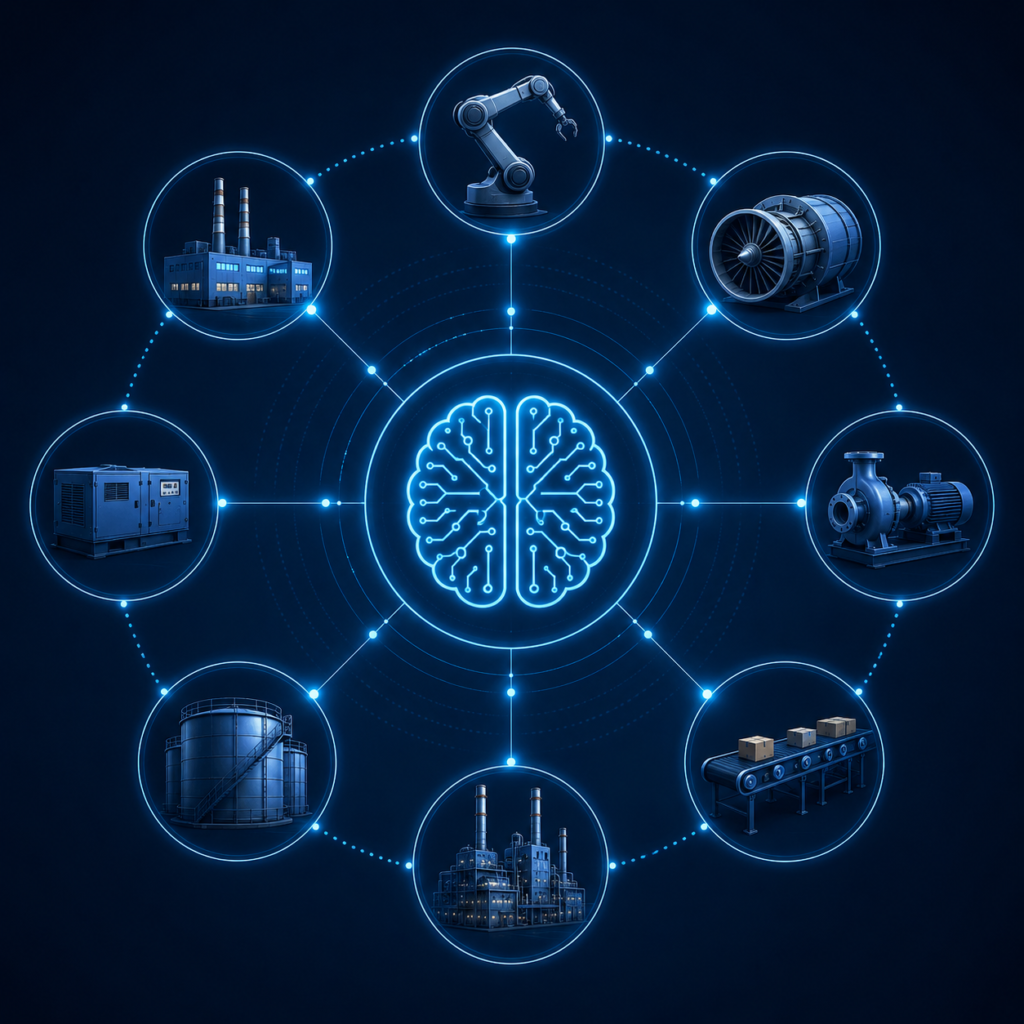
Once your predictive model proves its value for individual assets, it’s time to apply it consistently throughout your operation–including any other locations your company manages.
You can achieve enterprise-wide predictive maintenance rollout by following a few simple steps:
- Create shared asset classifications: Make sure assets across all locations follow the same naming conventions, failure codes, and data fields. That way, you can use the same predictive models across your enterprise
- Categorize asset criticality: Not all assets have the same maintenance cost or downtime risk. Organizing your assets based on criticality lets you prioritize high-volume, high-impact asset classes for maintenance
- Build baseline models before customizing: Start with global rules and models that you can apply across similar asset types. Over time, you can refine these based on site-specific behavior or environmental conditions to take more granular control
- Use LLumin’s facility-level rule management: LLumin CMMS+ lets teams deploy shared rules while giving site managers control over local exceptions. This lets you balance standardization with operation flexibility to achieve optimal results
- Deploy dashboard and reports by role and site: With customizable role-based dashboards, LLumin enables technicians, managers, and executives to choose what they see. Rather than wading through irrelevant metrics, you can immediately find and respond to the data that’s important for you
- Schedule regular model reviews across sites: As you collect more data, take time to review your model accuracy, alert rates, and maintenance outcomes. Then, use these insights to guide model retraining and benchmarking to reach your operational potential
- Document changes to models and rules: Always keep a versioned record of predictive rules and model updates. As well as supporting audits and benchmarking, it makes it much easier to troubleshoot any problems that could occur as your models evolve
Following a structured rollout plan ensures all your locations receive the full benefits of predictive maintenance. This turns standardized automation from a small experiment to an enterprise-wide driver of success.
How Predictive Insights Improve Production, Staffing, and Budgeting
AI-driven maintenance can have a profound impact on asset maintenance, boosting OEE by 20% and slashing downtime by 40%.
But it’s not just your assets that benefit from predictive insights. In fact, LLumin CMMS+ can improve how you plan and resource your entire operation.
How to Use Predictive Strategies for Resource Management
| Decision Area | How Predictive Insights Help | What Improves as a Result |
|---|---|---|
| Production scheduling | Identifies assets likely to require intervention so work can be aligned with planned downtime or slower production periods | Fewer mid-run failures and more stable output |
| Workforce planning | Forecasts where technician demand will increase in the coming days or weeks | Better shift planning and less emergency overtime |
| Budget planning | Highlights components trending toward failure so parts and labor can be forecasted accurately | More predictable spend and fewer rush purchases |
| Capital planning | Reveals long-term degradation trends that signal approaching end-of-life | Stronger justification for replacement and smarter capital timing |
| Procurement strategy | Surfaces high-risk or frequently failing components across assets | Improved vendor negotiations and optimized inventory levels |
| Leadership planning | Consolidates risk and performance data across sites | Clearer prioritization of investment to protect uptime |
Win Leadership Buy-In with LLumin’s Reporting Tools
The job of a maintenance manager isn’t just to streamline and improve asset management. That’s because any improvements you make need to be approved by leadership teams.
Convincing others of the value of predictive maintenance can be difficult when you explain it purely in mechanical terms. But with LLumin’s customizable dashboard and reporting features, it’s easy to set KPIs and measure success in terms leadership really cares about: improved metrics and ROI.
LLumin CMMS+ Reporting Tools that Win Leadership Approval
| Reporting Capability | What It Delivers | Why Leadership Cares |
|---|---|---|
| Real-time performance dashboards | Live visibility into uptime, production impact, cost exposure, and risk across sites | Protects revenue by reducing unexpected downtime and preventing small issues from escalating into production losses |
| KPI and trend tracking | Clear trends in reliability, downtime reduction, maintenance cost per asset, and planned vs reactive work ratios | Shows whether operational performance is improving and whether maintenance investment is producing measurable financial return |
| Predictive alert feedback loops | Insight into how many alerts prevented failures vs generated unnecessary work | Ensures predictive spend translates into real disruption avoidance, not increased labor cost |
| Historical failure prevention analysis | Quantified avoided downtime hours, emergency repairs, and asset replacement events | Provides defensible ROI through lower unplanned costs and extended asset life |
| Rule and model performance evaluation | Cross-site consistency in risk detection, response speed, and execution quality | Reduces variability across facilities and ensures enterprise-wide performance alignment |
Meaningful AI Transformation for Technicians, Managers, and Leadership
Condition-based monitoring is a highly effective way to improve maintenance management for individual assets. But for complete asset fleets, especially across multiple locations, condition signals give you too much disconnected information to lead substantial change.
By introducing AI-powered predictive and proactive maintenance, you enhance your organization with the rapid thinking needed to turn hundreds of data points into an effective maintenance strategy.
This doesn’t just improve asset value and lifespan. It drives improvements in every aspect of your operation, from scheduling and procurement to staffing and production.
But the value you attain from predictive maintenance depends on the quality of your maintenance management software. That’s why companies of all industries throughout the United States and worldwide choose LLumin CMMS+ to implement AI-driven predictive maintenance across their organization.
Book your free demo today to see first-hand the value LLumin CMMS+ can bring to your maintenance team.
Read Chapter Five
You’ll always need to perform a small amount of reactive maintenance. But with LLumin’s predictive models and automated workflows, you can reduce MTTR for unplanned work by up to 26%.
Download Your Blueprint to AI-Powered Predictive Maintenance

Chris Palumbo brings over 13 years of expertise in B2B sales across diverse sectors including Manufacturing, Food and Beverage, Packaging, and Pharmaceuticals. Leveraging 6 years of leadership experience, Chris has successfully guided sales teams within Manufacturing and Distribution to achieve success, particularly in large capital expenditure projects. As Director of Business Development for LLumin, Chris oversees the identification of business opportunities, pushing the development and implementation of a robust business development strategy aimed at accelerating revenue growth. With a proven track record of excellence, Chris has established himself as a respected industry leader and invaluable asset to the LLumin team.