
Chapter Two: What Predictive Maintenance Looks Like with CMMS
The Difference Between Collecting Data and Improving Decision Making
Most facilities already collect asset data. So why do only 35% of maintenance professionals report using sensors and Industrial Internet of Things (IIoT) data extensively?
That’s because there’s a difference between collecting data and using it to improve your asset maintenance strategy.
All the temperature, vibration, and pressure monitors in the world won’t help you if you can’t interpret, prioritize, and act on the data they provide. And as your inventory of assets expands and data comes in thicker and faster, simple threshold alerts end up creating noise rather than clarity.
A meaningful change in your maintenance strategy is only possible when you can analyze equipment data in context and use those insights to inform workflows. That means connecting your asset sensors with an AI-driven computerized maintenance management system (CMMS) software like LLumin.
Book your free demo now to see how LLumin CMMS+ helps you implement AI-powered predictive and proactive maintenance.

Read Chapter One
Explore the risks of time-based maintenance and discover how implementing use-based maintenance helps you achieve up to 90% Overall Equipment Effectiveness.
Basic Sensor Thresholds vs AI-Driven Monitoring
The Problem with Static Thresholds
Teams usually start with basic condition monitoring. This involves setting static thresholds like ‘a temperature over 150oF’ or ‘vibrations registering higher than 20’ to trigger alerts.
But these kinds of thresholds don’t account for factors like:
- Historical performance
- Variations between assets
- Environmental conditions
For example, a fan running hot in summer is perfectly normal. But if the same problem occurs in winter, the fan might already be on the verge of failure by the time it crosses the threshold.
Without adaptive thresholds, basic condition monitoring often results in too many alerts or too few. So teams are either flooded with warnings that don’t signify real risk or get too comfortable ignoring their monitoring systems.
AI Replaces Static Rules with Adaptive Models
AI-powered predictive and proactive maintenance models look at historical and real-time data to learn what ‘normal’ looks like for each asset. This includes taking into account seasonal changes in environment or use patterns.
It then flags deviations from that baseline even when they don’t cross a traditional threshold. So even if, say, machine amperage is still technically within range, predictive maintenance technologies can detect a gradual increase that signals internal wear.
LLumin’s AI-powered predictive maintenance can even assign risk based on a combination of factors like load, equipment age, and environment. This helps you prioritize urgent cases, supporting smarter maintenance and resource allocation.
When a failure does occur, LLumin updates its model to refine future predictions. This creates a self-improving feedback loop that adapts to the specific needs of your assets across multiple sites.
How AI Identifies Trends, Anomalies, and Early-Warning Signs
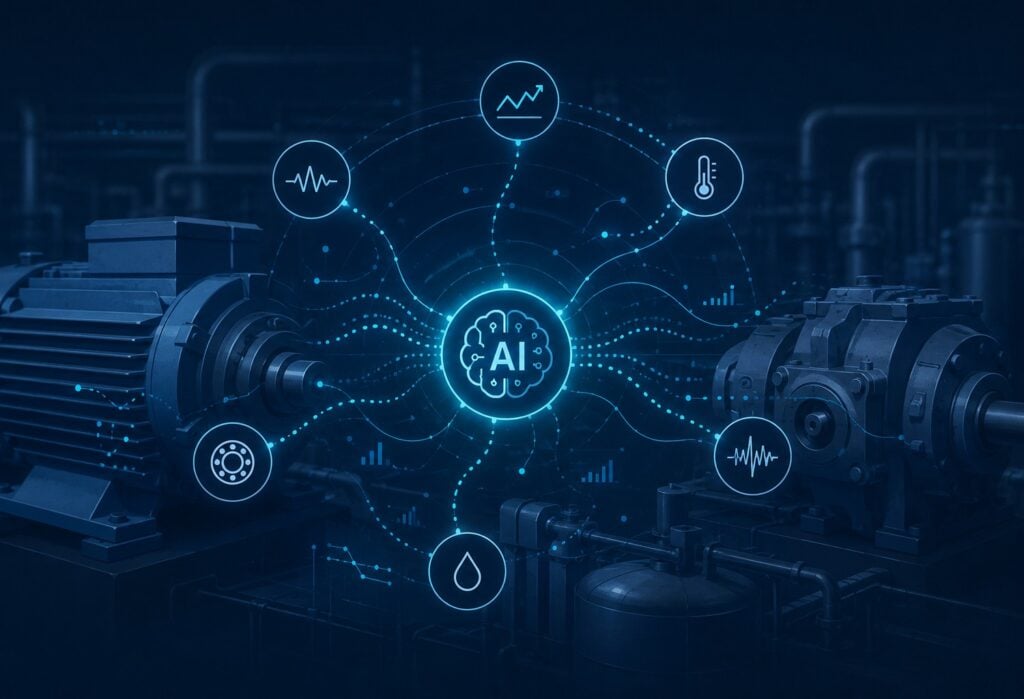
The role of AI in CMMS is to analyze multiple parameters simultaneously and in context. That way, it can detect many small changes at once to identify problems that single-sensor thresholds would miss.
But it’s not just about preventing individual failures. Over time, LLumin develops an extensive log of historical maintenance data, use information, and prior failure cases.
This lets the system compare today’s performance to last week, last month, last year, and beyond to spot subtle trends in asset performance and condition. And the longer you use it, the more accurate and valuable your AI model becomes.
Catching an issue two weeks before failure means a technician can schedule a part swap during planned downtime rather than reacting to a sudden breakdown. As a result, you can maximize uptime and extend asset lifespan, all while improving your maintenance efficiency.
How LLumin CMMS+ Connects Sensors, Rules, and Real-Time Alerts
Some integrated platforms simply read the data and present it in a way that’s easier to understand. But with LLumin CMMS+, you can completely automate work order management.
LLumin integrates seamlessly with IIoT devices, industrial controllers, and sensor networks to capture live equipment condition. Then, you can define rules based on thresholds, condition combinations, and AI to launch maintenance workflows that suit your capacity and needs.
When a rule is triggered, LLumin can:
- Generate a work order
- Assign it to an appropriate technician
- Reserve the necessary inventory
- Schedule maintenance for a suitable time
LLumin then logs the data, triggered rule, and maintenance outcome to support reporting and further refined its algorithm. That way, your predictive data is used to fuel continuous improvements in real-world response to asset wear.
Reach Your Maintenance Potential with LLumin CMMS+
| 40% Lower maintenance costs | 44% Reduced unplanned work | 35% Longer machine lifespans | 35% Less overall downtime |
| 40% Higher proactive maintenance | 26% Faster mean time to repair | 25% Lower staff costs | 99% Machine uptime achieved |
*Based on results achieved by real LLumin users
Should I Rely Exclusively on Predictive Maintenance?
When it comes to reactive vs proactive maintenance or preventive vs predictive maintenance, it’s important to remember that each approach is one part of a holistic asset maintenance management strategy.
Not every asset needs the same level of monitoring. For example, a critical pump might use predictive logic tied to vibrations and torque trends. But for a backup generator that rarely gets used, a simple runtime schedule is probably enough.
In terms of your maintenance budget, it’s generally recommended that you allocate:
- 60% to preventive maintenance: Most of your budget should go toward routine servicing that addresses predictable wear-related failures
- 30% to predictive maintenance: Supplement preventive works with condition monitoring and risk analysis for your most valuable assets
- 10% to reactive maintenance: Some failures are unavoidable, so you need to keep some money available to respond quickly
LLumin’s broad integration capabilities and customizable condition monitoring rules make it easy to create a balanced approach using all the main types of maintenance strategy.
That means you can apply the right model for each asset’s performance and value–with AI and machine learning algorithms that help you optimize your proactive maintenance strategy.
Automate Your Maintenance Workflows with LLumin CMMS+
Basic sensor thresholds tell you when a limit is crossed. But predictive models detect subtle changes over time, connecting operating conditions to typical failure cycles. That way, they can tell you that something’s wrong even if what you’re tracking stays within normal limits.
The difference isn’t just smarter detection. It’s smarter timing. That’s because AI-powered predictive and proactive maintenance lets you take action at the optimal time as the probability of failure rises.
LLumin CMMS+ operationalizes this intelligence, connecting live data and customizable rules to automate work orders, inventory checks, and technician assignment in one continuous workflow.
Use- and condition-based maintenance strategies still have value. But by introducing predictive capabilities into asset management, you add a forward-thinking layer that reduces emergency maintenance.
Test drive LLumin CMMS+ now to explore how you can introduce customizable condition monitoring rules into your maintenance management strategy.
Reach Chapter Three
Predictive maintenance doesn’t require full AI transformation. Find out how you can take your first step by making better use of the condition signals you’re already collecting.
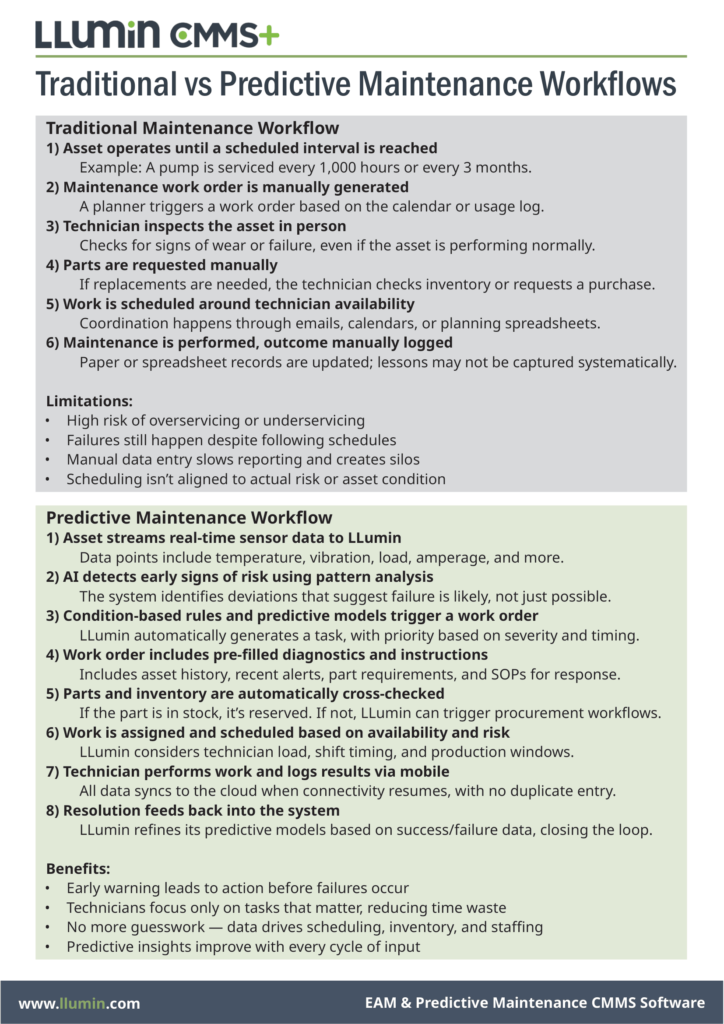
Download Your Maintenance Workflow Reference Sheet

Chris Palumbo brings over 13 years of expertise in B2B sales across diverse sectors including Manufacturing, Food and Beverage, Packaging, and Pharmaceuticals. Leveraging 6 years of leadership experience, Chris has successfully guided sales teams within Manufacturing and Distribution to achieve success, particularly in large capital expenditure projects. As Director of Business Development for LLumin, Chris oversees the identification of business opportunities, pushing the development and implementation of a robust business development strategy aimed at accelerating revenue growth. With a proven track record of excellence, Chris has established himself as a respected industry leader and invaluable asset to the LLumin team.