
Chapter One: Why Calendar-Based Preventive Maintenance Isn’t Enough
What You Gain in Simplicity You Lose in Efficiency
Planning asset maintenance on a fixed, recurring basis is simple and easy to scale. All it takes is a mark on a calendar or a quick reminder on your maintenance tracking software for technicians and leadership to see the forecasted workload.
That’s why calendar-based maintenance is the operational backbone of so many asset maintenance teams. And for basic, noncritical equipment with consistent wear cycles, calendar-based maintenance can work just fine.
But most asset wear isn’t polite enough to follow your schedule. By treating time as the main factor, you miss the dozens of other factors that affect asset conditions and resultant reliability.
The Limitations of Calendar-Based Maintenance

It Ignores the Real Causes of Asset Wear
Many facilities still rely on fixed schedules to trigger preventive maintenance tasks regardless of how heavily their assets are being used.
But while this eliminates the chance of total neglect and helps establish some maintenance discipline, it’s only one step up from a best guess.
Real-world asset wear doesn’t align neatly with time. In reality, when a component actually fails depends on many factors, including:
- How hard you work it
- How often it runs
- Start–stop frequency
- Overloading or misuse
- Operator habits
- Temperature extremes
- Humidity and moisture exposure
- Dust, dirt, and airborne contaminants
- Corrosion and chemical exposure
- Vibration from surrounding equipment
- Age and lifecycle stage
- Delayed or missed maintenance
- Poor-quality replacement parts
- Improper repairs
- Supply chain delays affecting timely maintenance
What Happens When You Only Consider Time
Ignoring a wide range of wear factors and relying mainly on calendar-based maintenance leads to one of two outcomes:
- Overservicing: Sending out maintenance work orders more often than necessary increases downtime, and inflates labor and parts costs. And every time a technician opens a machine, they risk damaging components, introducing debris, or misaligning calibrated parts, which can actually increase asset failure rates. It’s estimated that 30% of preventive maintenance is carried out too frequently.
- Underservicing: Delayed or insufficient maintenance allows wear to progress unchecked. This increases the likelihood of breakdowns, shortening asset lifespan and leading to higher unplanned downtime and emergency repair costs. 58% of facilities spend less than half their time on scheduled maintenance, leaving many assets vulnerable to failure.
Both overservicing and underservicing increase costs and put assets at greater risk. So any facility looking to save money, reduce downtime, and optimize labor efficiency should focus on establishing a smarter proactive maintenance implementation strategy.
The Impact on Your Maintenance Budget
Spending on unnecessary work or emergency repairs after failure makes it difficult for your maintenance department to prove the value you deliver. And when leadership doesn’t trust your ability to manage maintenance scheduling properly, it can be hard to justify investment to your CFO.
It’s not just about the money you spend, either. Poor maintenance scheduling also carries a lot of opportunity costs. That’s because every minute of downtime caused by overservicing or underservicing is a minute of valuable productivity lost.
How Use-Based Preventive Maintenance Improves Scheduling Accuracy
Reactive maintenance–that is, fixing things after they break–leads to less than 50% Overall Equipment Effectiveness (OEE). In contrast, planned maintenance results in 50-75% OEE.
In terms of asset health, overservicing is generally better than underservicing. But mainly relying on calendar-based maintenance can still leave up to 50% of your potential on the table.
Proactive maintenance, on the other hand, typically leads to greater than 90% OEE. And while an optimal proactive maintenance strategy can take some time to implement, you can get started right away with simple use-based maintenance.
Compared to calendar-based maintenance, use-based maintenance involves tying service intervals to real asset activity. That way, you trigger maintenance work orders based on the actual needs of your assets.
Most modern facilities already track factors like runtime, speed, load, cycles, and throughput with existing sensors, programmable logic controllers (PLCs), or telematics. So it’s just a case of pulling that data into computerized maintenance management system (CMMS) software, which 59% of facilities already use.
This simple change lets you:
- Capture wear more effectively: By linking service triggers to actual asset use, your team avoids the risk of overservicing or underservicing
- Set up multiple use-based triggers: Advanced systems like LLumin CMMS+ let you set thresholds for a range of use factors so you can customize use-based maintenance to your needs
- Predict when thresholds will be hit: Tracking trends and historical data in LLumin lets you forecast when triggers will occur, giving you time to plan labor, allocate parts, and schedule work
Even with basic data, switching from calendar-based to use-based maintenance can have a dramatic impact on your efficiency. And with LLumin CMMS+, you can build an effective preventive maintenance plan that:
- Reduces unplanned work by up to 44%
- Reduces overall downtime by up to 35%
- Improves proactive maintenance by up to 40%
- Cuts mean time to repair (MTTR) by up to 26% within 24 months
- Achieves up to 99% uptime
The Business Case for AI in Maintenance
Without real-time condition monitoring, it’s hard to know when an asset has passed an operating threshold. This can eventually lead to critical failure and unexpected downtime, creating more costs than simply spending a bit more on maintenance.
Depending on your assets and existing sensors, it’s possible to set up a use-based maintenance schedule in as little as a week–especially with LLumin’s proven CMMS implementation strategy.
Once that’s underway, the next step is to introduce artificial intelligence (AI).
AI-powered predictive and proactive maintenance does much more than tell you when asset conditions reach certain thresholds. They use historical data to forecast failure risk, suggest likely causes, propose responses, and even recommend adjustments to your existing schedule.
That way, you’re not just waiting for assets to fail. You’re addressing the root causes of asset failure and solving them before they interrupt your operation.
Benefits of AI-Powered Predictive and Proactive Maintenance
| Benefit | How It Works | Potential Impact |
|---|---|---|
| Fewer unplanned breakdowns | AI-driven monitoring detects degradation patterns early, so you can intervene before assets fail | Reduces breakdowns by 70% |
| Higher technician productivity | Maintenance is prioritized by risk, so technicians can focus on assets that actually require attention | Increases productivity by 25% |
| Lower costs | Better maintenance timing reduces unnecessary labor, emergency repairs, and wasted parts | Lowers maintenance costs by 25% |
| Reduced downtime | Earlier detection and smarter scheduling minimize unnecessary equipment shutdowns | Reduces downtime by 20-50% |
| Faster maintenance planning | Predictive insights automate prioritization and reduce time spent manually assessing risk | Reduces maintenance planning time by 20-50% |
| Improved uptime | Continuous monitoring keeps assets operating within safe thresholds and reduces unexpected stops | Increases equipment uptime and availability by 10-20% |
| Lower spare parts spend | Maintenance is triggered based on condition rather than routine, reducing excess parts use and stock levels | Reduces inventory levels by 10-30% |
Source 1 | Source 2 | Source 3

See How Much You Could Save with LLumin CMMS+
From Calendar to Use to AI: Achieving Optimal Maintenance Efficiency
Starting with a calendar-based strategy is a good way to establish maintenance discipline. But it can’t respond to changing asset conditions. This creates a persistent gap between service timing and actual risk.
Use-based maintenance narrows that gap by aligning service with operational demand. This improves scheduling accuracy and labor planning, thereby reducing maintenance spend and overall downtime.
But only AI-powered predictive and proactive maintenance is able to automatically capture real patterns of degradation by analyzing a range of causes.
Preventive maintenance isn’t obsolete. In fact, it’s an essential part of any thoughtful asset management strategy. But AI-driven maintenance managed with an advanced platform like LLumin CMMS+ is the key to achieving the greatest possible uptime, MTTR, and return on investment.
Test drive LLumin CMMS+ to discover how asset management software can transform your maintenance activities.
Read Chapter Two
Find out how you can replace static alert thresholds with adaptive rules based on real data to interpret and use asset data for better maintenance efficiency.
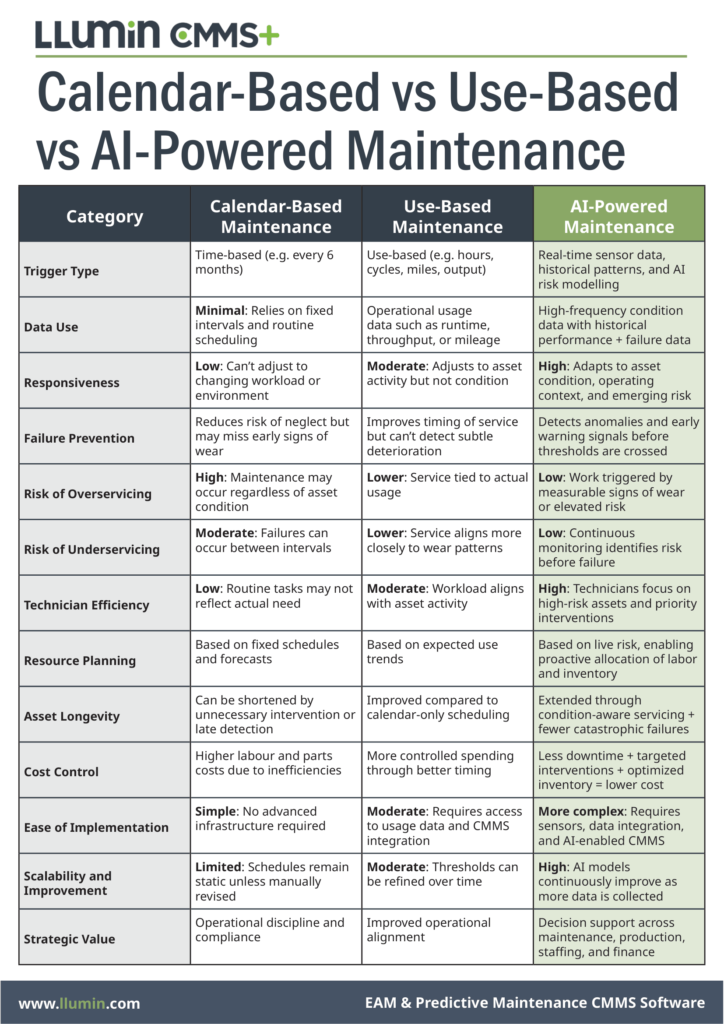
Download the Maintenance Comparison Cheat Sheet

Chris Palumbo brings over 13 years of expertise in B2B sales across diverse sectors including Manufacturing, Food and Beverage, Packaging, and Pharmaceuticals. Leveraging 6 years of leadership experience, Chris has successfully guided sales teams within Manufacturing and Distribution to achieve success, particularly in large capital expenditure projects. As Director of Business Development for LLumin, Chris oversees the identification of business opportunities, pushing the development and implementation of a robust business development strategy aimed at accelerating revenue growth. With a proven track record of excellence, Chris has established himself as a respected industry leader and invaluable asset to the LLumin team.