
How Universities Use CMMS to Maintain Aging Campus Infrastructure
Even when budgets are tight, you can keep your university campus in top shape with preventive and proactive maintenance fueled by CMMS for universities. Yet many campuses operate buildings and utilities that are decades old, with a staggering $112 billion maintenance backlog threatening the foundational infrastructure of higher education institutions nationwide. Moody’s Ratings estimates that colleges will need to spend up to $1 trillion over the next decade to repair and maintain their campus infrastructure, as deferred maintenance accumulates quietly, increasing the risk to safety, reliability, and the student experience.
This article examines how campus maintenance software transforms aging campus infrastructure management through university facilities management systems, CMMS for education platforms, and the higher education maintenance systems that enable data-driven asset lifecycle management.
Campus Maintenance Software for Higher Education
Deferred maintenance backlog continues to accumulate despite facilities teams’ best efforts, creating an accelerating deterioration cycle where emergency repairs cost significantly more than preventative maintenance would have. Every $1 in deferred maintenance will cost education facilities $4 in future capital renewal needs, according to research from Pacific Partners Consulting Group, which transforms manageable upkeep into a financial catastrophe when repairs are delayed.
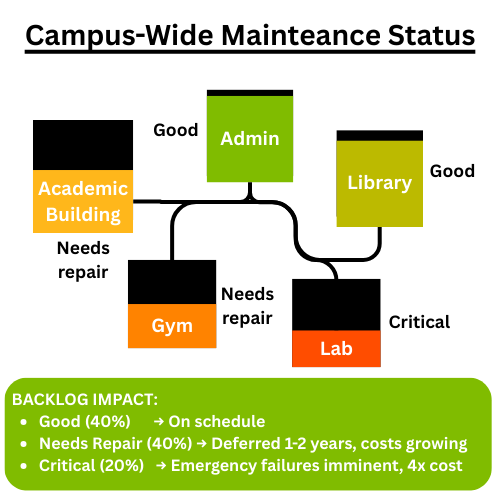
With comprehensive maintenance management platforms, teams gain unified visibility into which buildings require immediate attention, which can be monitored, and which deferred repairs are becoming critical through campus-wide asset visibility. This centralized approach enables data-driven maintenance prioritization, preventing the most catastrophic failures while maximizing the impact of a limited budget.
How Universities Prioritize Maintenance When Budgets Are Constrained
Facilities teams must decide which assets to repair now, which to monitor, and which to defer without compromising operations. These decisions become exponentially more difficult when 63% of institutions were only able to fund up to a quarter of identified maintenance needs in fiscal year 2024.
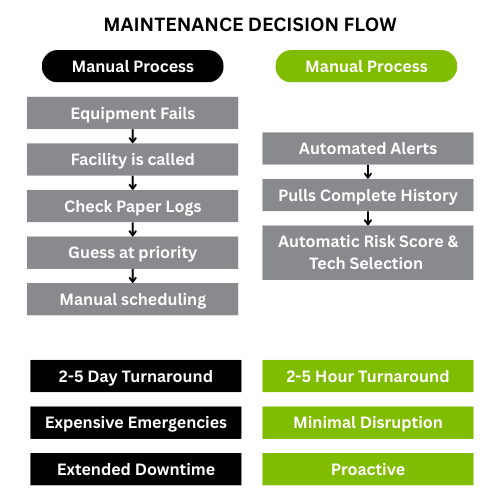
Without centralized data, prioritization often relies on anecdotal reports or isolated spreadsheets rather than objective assessment of asset criticality, condition, and risk to safety or operational continuity.
An integrated system consolidates all related data into a single platform, enabling teams to view requirements, deadlines, and service proofs without needing to switch between tools. This unified maintenance documentation ensures accuracy, supporting evidence-based prioritization under severe budget constraints.
Using CMMS to Coordinate Maintenance Across Large, Complex Campuses
University maintenance spans academic buildings, laboratories, residence hall maintenance facilities, sports venues, and central utilities, creating coordination challenges when disconnected systems make it difficult to track recurring issues across locations. 50% of facilities professionals cite qualified worker shortages as their most pressing challenge, meaning the remaining staff must coordinate work more efficiently across sprawling campuses with aging infrastructure.
LLumin CMMS+ makes it possible to manage work orders, assets, and schedules from a single, shared system through facilities operations coordination that eliminates the information silos causing inefficiency and extended response times across multi-building campuses.
Preventive Maintenance as a Strategy to Extend Asset Life
Aging infrastructure requires proactive care to delay costly capital replacement, yet missed or inconsistent preventive maintenance accelerates deterioration and increases emergency repairs that disrupt campus operations. Students and faculty endure consequences daily; for example, at Fresno State, approximately 62% of campus buildings are over 60 years old. As a result, students experience indoor temperatures reaching 110 degrees due to outdated air conditioning that can’t keep up with extreme heat, forcing some to abandon in-person classes entirely.
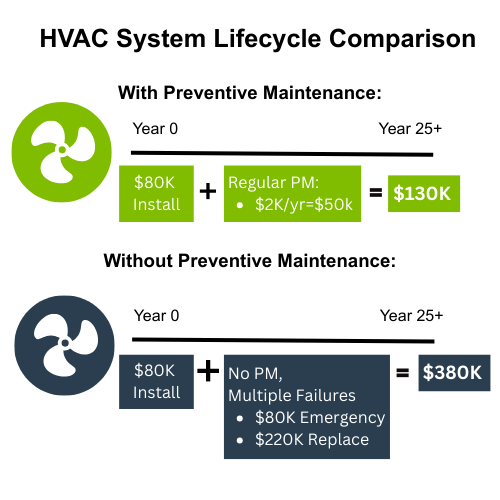
In LLumin, preventive maintenance scheduling is automated and tracked to ensure critical maintenance is completed on time through preventive maintenance proof that extends asset life and prevents the emergency failures that disrupt campus operations and drain budgets.
Managing Staffing Shortages and Contractor Reliance
Many universities rely heavily on external contractors for campus maintenance operations, creating oversight challenges when poor visibility into work history and contractor activity weakens accountability. Organizations that invest in maintenance programs decrease downtime by an average of 44% while reducing defects by 54%, demonstrating substantial operational efficiency gains that can be achieved through proper coordination of mixed in-house and contractor workforces.
LLumin CMMS+ centralizes work histories and contractor records to maintain control even with mixed workforces through service provider coordination that ensures accountability regardless of who performs the work.
Supporting Sustainability, Safety, and Compliance Goals
Universities must meet safety standards, energy targets, and regulatory requirements across diverse facilities, yet isolated systems make compliance reporting and audits time-consuming and error-prone. At UC Davis, where facilities span 63 million square feet across the system, rats chewed cables powering $2 million of temperature-sensitive research equipment in the 86-year-old Hickey Gymnasium building, forcing a professor to cancel experiments and halt research that directly impacts patient care. This incident demonstrates how deferred maintenance compromises institutional mission beyond just comfort.
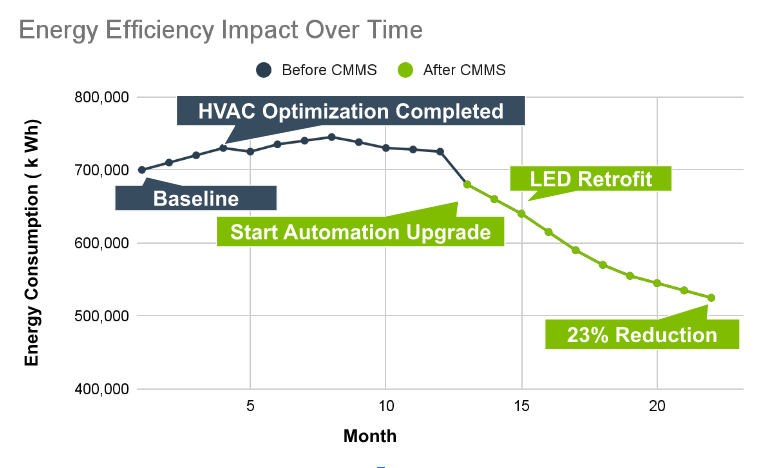
Maintenance data in LLumin supports inspection tracking, compliance documentation accuracy, and sustainability reporting that demonstrates progress toward institutional energy efficiency initiatives without manual compilation from scattered sources.
Choose LLumin CMMS+ for Smarter Campus Maintenance
Universities can’t solve aging campus infrastructure challenges through capital investment alone when state funding remains sporadic, providing hundreds of millions in some years and nothing in others. A comprehensive CMMS enables data-driven capital planning in higher education, protecting assets, supporting safety goals, and stretching limited budgets through systematic maintenance prioritization and asset lifecycle management strategies.
LLumin CMMS+ provides Higher Education Facility Management solutions specifically designed for the unique challenges of university campuses, from residence hall maintenance coordination to academic building upkeep across sprawling physical plants. The platform’s emphasis on facility operations coordination and preventive maintenance scheduling ensures that the deferred maintenance backlog stops growing while enabling systematic long-term infrastructure planning.
Book a demo to see how LLumin CMMS+ helps universities manage aging campus infrastructure more effectively through centralized asset visibility, automated maintenance request tracking, and cross-campus asset visibility that keeps facilities teams in control regardless of budget constraints.
Frequently Asked Questions
How does a CMMS help universities manage aging buildings?
A CMMS helps universities manage aging buildings by centralizing all maintenance histories, automating preventive maintenance schedules that prevent accelerated deterioration, prioritizing repairs based on data-driven risk assessment, and tracking contractor work across sprawling campuses. The $112 billion maintenance backlog threatens higher education infrastructure, making systematic management essential. LLumin CMMS+ provides the visibility and control needed to make every maintenance dollar count through strategic asset lifecycle management.
What types of campus assets should be prioritized in a CMMS?
Campus asset prioritization should focus on life-safety systems (fire suppression, emergency lighting, and elevators), mission-critical infrastructure (HVAC, electrical, and plumbing systems), assets subject to regulatory requirements (such as labs and healthcare facilities), and high-traffic facilities (including residence halls and academic buildings). Clearing maintenance backlogs costs facilities $140 per square foot in accumulated repairs, making proper prioritization essential. LLumin CMMS+ enables condition-based prioritization that balances safety, operational impact, and available budget.
Can a CMMS support both preventive maintenance and long-term capital planning?
A CMMS supports both preventive maintenance and capital planning by maintaining complete asset histories that inform replacement timing, tracking the total cost of ownership to justify capital investments, forecasting future capital needs based on asset age and condition, and demonstrating ROI from systematic maintenance versus emergency replacements. Every $1 in deferred maintenance costs $4 in future capital needs, making integrated planning critical. LLumin CMMS+ provides the long-term data visibility that supports strategic capital planning decisions.
How do universities use CMMS data to justify maintenance budgets?
Universities use CMMS data to justify budgets by demonstrating actual maintenance completion rates versus needs, showing cost escalation when repairs are deferred, quantifying emergency repair costs versus preventive maintenance, and proving compliance with safety and regulatory requirements. 63% of institutions fund less than a quarter of identified maintenance needs, making data-driven budget justification essential. LLumin CMMS+ generates reports that clearly communicate maintenance value to administrators and legislators who control funding.
How does LLumin CMMS+ support large, multi-building campuses?
LLumin CMMS+ supports large campuses through centralized work order management across all buildings, mobile access for technicians working throughout campus, automated routing based on location and skills, unified asset database for the entire physical plant, and cross-campus reporting that reveals patterns across facilities. 50% of facilities professionals cite staffing shortages as their top challenge, making efficient coordination essential. The platform’s multi-site capabilities ensure consistent maintenance standards regardless of campus size or complexity.

With over 15 years of experience, Ann Porten stands as a seasoned leader in asset management, ERP Solutions, and B2B Sales. Her extensive background in manufacturing has equipped her with unique insights, enabling her to navigate complex software solutions with precision and drive results. Currently, as the Director of Business Development for LLumin, Ann has led various industries, including Manufacturing, Construction, Pharmaceuticals, Food & Beverage, and Oil & Gas to identify their business opportunities and challenges, and implementing profitable solutions. Her reputation as a trusted advisor and industry leader stems from her dedication to delivering economic success and satisfaction to the customers she serves.